
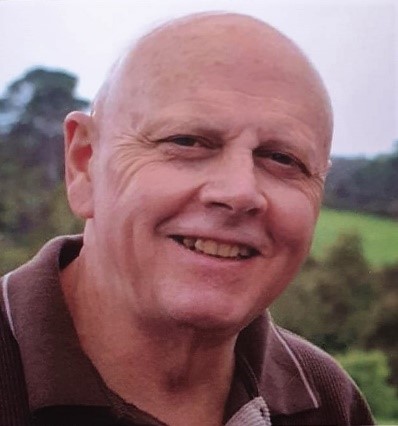
Charles Theron passed away peacefully on his small retirement farm on the northern outskirts of Auckland, New Zealand on 19 November 2020 at the age of seventy after a two-year battle with a rare lung cancer. He is survived by his wife Jenny, his children Liesle, Greg, Gillian and Lynette, seven grandchildren, and his sister Lee.
He graduated from the University of Pretoria with MBChB and MMed (Anaes) degrees, in 1973 and 1978 respectively, and was awarded FFA(SA). He later was also awarded fellowships of the New Zealand and Australian colleges. He practised as a specialist anaesthetist in pre-eminent partnerships in Pretoria and Westville before emigrating with his family in 1994 to New Zealand where he practised in Wanganui and Rotorua. Charles retired from medicine on his 65th birthday and moved to Auckland where three of his four children live.
He attended PBHS from 1963 to 1967 as a day boy and described himself as average. He enjoyed playing rugby but was concussed on several occasions. The last incident was at under 15 level when he only woke up in hospital. He was advised by a neuro-surgeon to avoid contact sport. Cricket never held the same attraction for him although he played interhouse cricket for Sunnyside.
In a humorous and unpretentious memoir written recently for his children and grandchildren Charles wrote: “There are many things in life that happen by chance that have a major influence on your life. Some good and some bad. Going to that school was one of the major good and positive things that happened to me. ……… It is always said that your school years are the best years of your life and it may not be entirely true but in my case it was pretty close. I loved my time at PBHS.”
His time at PBHS was unexceptional but solid, and it provided him with the foundation for later significant academic and professional success.
Charles Theron was born in Pretoria on 30 June 1950. He attended three primary schools, each close to home as the family moved house from Arcadia to Brooklyn and then to Waterkloof. In 1963 it was on to PBHS. He fondly remembered icons such as Bob Fair, Mrs Erasmus and Mrs Smith amongst many others. He described Bob Fair as “a great and pleasant man and I loved him. His way of teaching was eccentric to say the least we were mostly left to ourselves and told to read books and poetry. He told us which were the best poems to read and I still read them to this day.” Charles described Mrs Smith (Latin) as “the epitome of formidability”. Many of the teachers left indelible impressions on him, mostly good.
Charles decided to defer his national service obligation to move on to university directly after school. In 1968, armed with only his first-class matric certificate, Charles enrolled at the University of Pretoria (UP). There was no pre-selection for admission to medicine at the time and he was in a group of 1500 aspirant doctors and dentists admitted to first year in the medical faculty. Tuition fees for the year were R130. He was registered as a BChD 1 student. The huge group of 1500 was whittled down to 250 students by the beginning of second year and Charles was in that select group. At the start of third year Charles registered as a MBChB 3 student, changing from dentistry to medicine. Each year proved to be more absorbing and Charles enjoyed the challenge.
In July 1972, during his fifth year at university, Charles married his “life’s anchor”, Jenny Boyack. They had met seven years earlier at the Brooklyn Methodist Church Guild while they were still at school. Jenny’s income as a secretary at the CSIR was sufficient for their needs and they rented a small flat attached to a house in Lynnwood Road for R25 a month.
Charles graduated with a MBChB at the end of 1973 and commenced his houseman year in 1974 at the then HF Verwoerd hospital. He continued to enjoy the academic environment while working under the supervision of many impressive senior colleagues. In spite of the onerous workload and hours, Charles thrived and decided he would stay on at “HF” for at least another year.
In his houseman year in 1974 Charles and Jenny took the plunge and scraped together the cash needed to augment a building society loan to buy a house in Lynnwood. 519 Dawn Avenue was carefully chosen to accommodate the proposed construction of a 45 ft ketch that he dreamed of building with three PBHS friends, Theo Bohlmann, Phil van Niekerk and Peter Dieterich.
The yacht took shape over years and became something of a local landmark. Lodestone was eventually completed after 12 years of work, mostly on Saturdays, and frequent financial reprioritising. She was launched in Durban in December 1985. Two weeks later the yacht had been inspected and given the Port Captain’s off-shore clearance certificate. Over the next four years Lodestone was moored at Point Yacht Club and sailed up and down the coast and to the islands of Mauritius and Reunion by the builders, usually with Charles as skipper as he had obtained his Yachtmaster ticket.
Lodestone was sold in June 1990 to a Durban family and the new owners sailed her to the island of St Maarten via St Helena and many South American stops with attendant adventures. Extensive sailing in the Caribbean followed as well as a cruise to Florida and up the US Intracoastal Waterway and further up the Potomac to Washington DC. Lodestone was badly damaged on 5 September 1995 while anchored in St Maarten’s Simpson Bay lagoon when the eye of Hurricane Luis passed directly over the island with 200kph winds. The yacht was subsequently scrapped in an insurance settlement. But back to Charles’ career.
Towards the end of his houseman year in 1974 he was offered a deal by the South African Medical Services. If he joined the Permanent Force he could comply with his national service obligation and would be able to resign after two years with no further military commitments. He weighed this offer against the prospect of one year of citizen force service to be followed by ten years of one-month camps thereafter. He opted for the deal.
In 1975 Charles commenced his military service as a medical officer at 1 Military Hospital. The “secret” border war was escalating from border protection to full blown hostilities and across border incursions. Charles was caught up in a spiral of escalating challenges as increasing numbers of casualties were hospitalised. He did not shrink from challenges and volunteered to administer an anaesthetic when no qualified anaesthetist was available.
Charles recounted: “Afterwards he (the CO) said he could see I knew what I was doing and from Monday I would be working in the anaesthetic department. From then I was really at the sharp end of the trouble. I got very good at it and soon I was the go-to man for anaesthetic problems, inexperienced as I was, and the idea began to form in my head that anaesthesia may be my future”.
Towards the end of 1975 the war situation was worsening dramatically and over the next years Charles was often flown up to Grootfontein and Rundu in a variety of fixed wing aircraft and helicopters to assist with the repatriation of badly wounded and dying servicemen. The injuries were very traumatic and the situations emotionally taxing. It was emergency medicine in the extreme.
In 1976 Charles registered for MMed(Anaes) at UP as 1 Military Hospital was newly recognised for training in anaesthetics. Two consultants were appointed to cope with the huge load of emergency work and reconstructive surgery. Charles thrived in this environment and enjoyed the academic detail.
After eighteen months Charles decided he was ready to sit for the primary exams for both the college and MMed at UP. He passed these with relative ease, as was the case when he sat for his finals. He described this as a wonderful time in his life culminating in being first awarded the FFA(SA) and months later he graduated with an MMed.
Early in 1980, with his training completed, he resigned from the military. His envisaged two-year “deal” had stretched to five years in the Permanent Force. During these years he had been exposed to exceptional opportunities to learn and develop skills. It had been a win-win deal. He was discharged with the rank of major. He had never been drawn into combat while the country was at war on the border and beyond, but he had contributed significantly, frequently critically, when assisting the casualties of the war.
On resigning from the permanent force in February 1980 Charles was appointed in a lecturer’s post at UP. A few weeks later a new opportunity arose. He was offered a position as an associate, followed by full partnership, in Pretoria’s premier anaesthetic practice. There were nine partners who provided anaesthetic services at hospitals all over Pretoria. The workload was often hectic, as were the after-hour calls. His “record” was administering anaesthetics at nine different hospitals in one day.
With Lodestone moored in Durban in 1986, Charles considered relocating to Durban. It was a huge decision to resign his partnership and start again. He took the plunge and he became a partner in a firm of 32 anaesthetists that ran the whole city’s anaesthetic service. The culture was far more laid back than in Pretoria, no suits, no ties. The partnership worked mainly at four big hospitals, one of which they owned.
It was possible to schedule work all day in the same hospital without rushing around. Charles was involved in every part of practice that could involve anaesthesia. Neurosurgery, cardiac surgery, vascular surgery, general surgery, orthopaedics, O&G, ENT, maxillofacial surgery, urology and all the rest, including running the four intensive care units in the city.
At this time Charles, together with one of his partners, bought a share in a farm north of Greytown where they ran 300 cattle, mostly Nguni. It was the haven for many good weekends and holidays. With a heavy workload and stress Charles realised his lifestyle needed to change. He decided to start running after jogging around their block in suburban Cowie’s Hill. Five months later he joined Westville Athletics Club and he was in a routine of rising at 04:30 to run with a group till 06:00 before returning home to clean up before work.
Half marathons became full marathons, and four Comrades Marathons and a Two Oceans followed. The last Comrades he ran was the day before he flew to New Zealand to firm up a job offer in Wanganui.
In 1994, after nine months of mental pain and anguish, Charles decided to move the family to New Zealand. He went on ahead and started working at a Crown Heath Enterprise (government) hospital in Wanganui as one of six anaesthetists on staff. The family joined him, they bought a house, and were soon integrated into the friendly and kind community. Life was good. The children were enjoying school and Charles’ golf handicap fell to thirteen.
In 1996 however, after two years in Wanganui, the hospital was audited by a cost cutting team of government bureaucrats and the anaesthetic compliment was reduced from six to four and a half! On a LIFO basis Charles was the first to leave. He took up a hospital post in Rotorua as one of seven anaesthetists on staff. He and Jenny bought a very attractive house on the shore on Lake Rotorua where they stayed for the next nineteen years. Once again life was back to normal with the children at school and university. In time Charles became head of department and was able to institute several improvements in the running of the hospital, including involving the nursing staff in decision making. Ultimately the bureaucracy of management by committee became too much and he felt chronically tired as he was simply wearing too many hats. In 2002 he resigned his post.
The last phase of Charles’ medical career was once again that of specialist anaesthetist in private practice. He had estimated that there would be sufficient private work for him in Rotorua to ensure financial security. He said: “My working life, financially, clinically and from a social aspect in my relationships with the doctors and nurses I worked with was by far the most pleasant I experienced all through my career and I enjoyed going to work. The surgeons were just about all personal friends and we socialised a lot. There was no political correctness and a lot of laughter and joking. I could see all my own patients at pre-admission clinics and then see them every day till they went home.”
When Charles turned sixty he told his colleagues that he would retire at the age of sixty five irrespective of his cognitive and professional abilities. He said: “Rather leave when everyone wants you to stay, than stay when everyone wants you to go.” He retired from medicine in June 2015, and he and Jenny moved to their retirement property. They had bought a small farm in 2007, midway between Albany and Silverdale on Auckland’s North Shore. The 17 Ha property is in rolling countryside and the grass is kept trim by ten heifers which are bought in as weaners and sold after two years. A second dwelling was built on the property by Charles’ son Greg.
Towards the end of 2018 Charles was troubled by a persistent cough and a subsequent scan revealed multiple small lesions in his lungs. Chemotherapy commenced in February 2019. Charles was strong enough to undertake a trip in October with Jenny and friends to take in, amongst other bucket list items, the Edinburgh Military Tattoo.
On his return to Auckland the therapy continued on a weekly basis. Charles was feeling increasingly tired and breathless. He continued with jobs on the farm up to a few days before his sudden, but ultimately expected, passing.
Submitted to Pretoria Boys High School Old Boys Association by Peter Dieterich, peter@dieterich.co.za, November 2020