
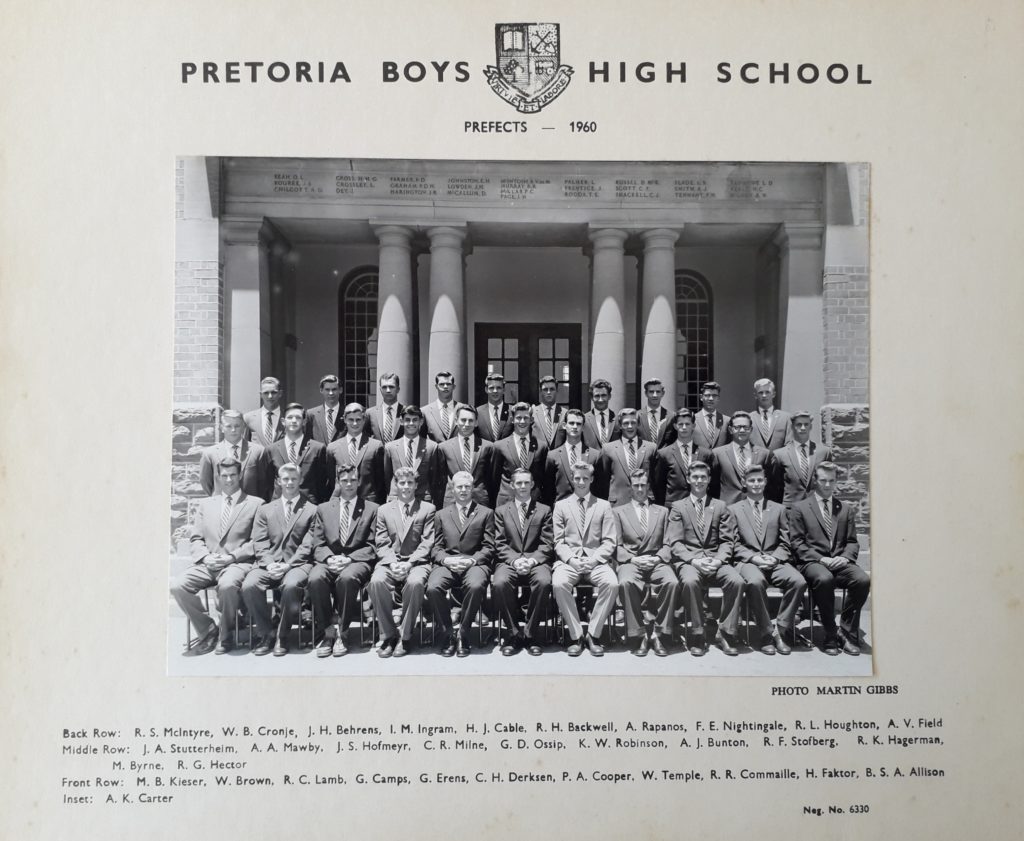
KERNEELS DERKSEN, HEADBOY OF NOTE
It’s with great sadness that we learned of the passing on June 12 2020 of Cornelis (Kerneels) Derksen, Head Prefect of the School sixty years ago.
Sadly, he had suffered for about a year from prostate cancer that metastasized and spread throughout his body, leaving him extremely weak and bedridden with considerable pain.
Charming, popular and a constant friend and companion to many, tributes from his former contemporaries have pointed unequivocally to his wonderful rapport with all, marvelous sportsmanship and a delight in any company.
Generally remembered as one who fully aligned himself with PBHS’s values, Kerneels exhibited considerable honesty and integrity; showed a proactive and caring approach towards teachers and learners alike; and was passionate about making a difference.
Said Gordon Erens, his Deputy in 1960: “To some, Kerneels seemed aloof and unconcerned. Not at all. It was the ‘people’ person in him that made him the successful and respected Headboy that he was. The prefect corps of 1960 was particularly large, some 20 individuals, and no easy task to manage, but he did so fairly and with equanimity.
“Academically, Kerneels was well above average in all subjects, liked Maths and Science particularly, and did very well in German and Afrikaans. He had an enquiring mind and was scientific in his approach to all issues. In Matric he was marked to be the 1st XV hooker, but unfortunately broke his arm and missed the season”.
A mere four days older than Gordon, they were in the same class for most of their time at Boys’ High. Kerneels was born on March 15 in Kroonstad, attended the Volkskool in the town, and in 1955 his family moved to Pretoria.
His immediate forebears were well ensconced in the medical field. His grandfather practiced as a GP in Kroonstad from 1919 to 1960; so did his father, who later specialized in Pretoria as a surgeon, and who was subsequently appointed as professor of surgery at Pretoria University.
Kerneels was the eldest of the four Derksen siblings. His sister, Nellie, attended Meisies’ Hoer, and his brothers Chris and Anton, went to Seuns Hoer.
In 1968 Kerneels married Helen Hofmeyr, daughter of Prof Chris Hofmeyr, head of the Department of Surgery at Onderstepoort and who had obtained wide international recognition for surgical expertise and academic excellence.
The two families spent many December holidays together in their respective holiday homes in Plettenburg Bay, leading to Kerneels taking Helen as his bride. She had matriculated at Meisies’ Hoer and went on to graduate in nursing at Pretoria University.
Kerneels entered Pretoria University in 1961 to study medicine, graduated in about 1967, and in 1969 worked at Columbus University Hospital in Ohio for six months, but was obliged to return home because of his father’s serious illness. Subsequently, Kerneels specialized in Urology at the former HF Verwoerd Hospital and then went into private practice in Pretoria.
A finger injury sustained in 1997 forced him into early retirement, resulting in a switch to full-time farming on the family property in the Kroonstad district. He retired ultimately in 2012 and moved to Stellnbosch.
Reminiscences of Alan Bunton and Gordon Erens, life-long friends and contemporary of the Class of 1960:
Alan Bunton
Friendship
is a strange thing. More than often, there is no logic to it.
Certainly, my friendship with ‘Herr Dokter’, as I called him, defied logic.
Unless perhaps, it was a case of opposites attract.
To list a chronology of his achievements, seems empty and cold.
What is more important is, how for the last 60 years or so, I grew
increasingly fond of him.
We spent a fair amount of time together, and in his last days, we
agreed we should have spent more time together.
He enjoyed discussing politics, and enjoyed discussing people he admired.
When his grandchildren came along, this was a point of more
affectionate discussion.
Of course Helen was a great facilitator.
She created the environment that was so conducive for hours of
pleasant conversation.
She would smile, when she heard us ranting on about things, and bring
in more rusks and coffee.
Herr Dokter retired about the same time as I did, and as we lived
quite close to one another, him in Olivier Street and me in Premier
Avenue, we used to meet and then stroll around Waterkloof together.
Two old bokke with a lot of years to share together.
A week before he died, we spoke for some time on the telephone, me in
Los Angeles and him in Stellenbosch.
His voice was strong, and as usual, he was more inclined to discuss my
ailments than his own.
He was many different things to me, and I valued them all.
He was fond of saying that we are all in “injury” time, and now that
he has finally been pushed over his own goal line, I feel tremendous
sorrow.
Marijke and I take some consolation from the fact that our families
will still stay close.
Life goes on, but it will not be the same.
Gordon Erens
Questions. And more questions. The state of the nation – politics, the economy, religion, the world’s population – or the current issues of the day, most recently the best strategy for Covid19. Incisive questions that put one on the spot. The debates were long and often heated, although always friendly.
For some 60 years this has been the basis for the relationships of los tres gran amigos – the three great friends – Kerneels, Alan Bunton and me.
The debating began in our last years of high school when we were prefects together. During break in the prefects’ room the questions would come, often led by Kerneels, our principal interrogator, a role which persisted after school. Oddly, even though we were ‘three’, it was generally a dialogue between just two of us.
We seldom met as trio. Separated by careers, geography and timing there were few opportunities for that. But whenever two of us met the health, welfare and opinions of the absentee were discussed and so we remained a mutually informed close-knit trio.
First and foremost Kerneels was a ‘people person’ and his first interrogation when we met was the state of my health and life. Then that of Marena, my wife, and my daughters. After that of Alan and other mutual friends.
For me the most astounding example of his concern for others was on his 50th birthday party, at his home in Olivier Street. There must have been 40 or more guests. After the traditional happy birthday wishes he asked us all to remain standing, spread around him. He then proceeded to say quite a few words to every man and women present. Not just thankyou but several remarks on their friendship and what it meant to him. Altogether a heart-warming performance.
To go back to the beginning. Kerneels and I met in 1956 in Form I. We were both in the Under 13A rugby team, and subsequently Under 14A and Under 15A teams. (For the record one of the most successful Boys High rugby teams ever. In three years we won all our games). In Form IV we were still together, in thirds.
In school, from Form II until matric we were in the A class together. Those times in class and rugby laid the basis for our long friendship.
After school we both moved on to Pretoria University, me to study science and Kerneels medicine, following the tradition set by his grandfather and father. Although we were students on different campuses, we became firm friends through our love of outdoor activities. As members of the Exploratio Club we embarked on numerous adventures together, including diving trips in Mocambique and week-long hiking trips.
Later, on completion of our studies, Kerneels practiced as a very successful urologist in Pretoria and I lectured at Unisa. Our wives, Helen and Marena became friends, with children of similar ages, and our two families visited particularly in the December holidays around Plettenberg Bay.
In 1995 Marena and I moved to Sydney so our meetings became far less frequent, but we maintained contact, phoned frequently and met up whenever we visited South Africa. Alan too later moved away, to Los Angeles, but the three-way conversations and debates continued, if anything better than before as aided by modern communications.
Quite evidently Kerneels became my medical muse. Any medical procedure that was proposed to me by any other doctor I subsequently discussed with him. He saved me from the knife quite a few times. When I was approaching 50 and I consulted him about some odd body ache he gave me particularly good advice – he said “If you wake up one morning without any pain you must know you are in heaven”. I learnt from him that many pains recede with time and exercise.
Thus, when we visited him in Stellenbosch last July, after our arrival welcome he suggested Helen and Marena ‘kuier’ while the two of us retired to his study. And the inquisition began. How was my health? More particularly how was my prostate? How often did I need to wee? He was adamant that when I returned home I should have a thorough inspection. And he informed me that his prostate cancer had advanced and the prognosis was not good. Already he was very weak. Subsequently an inspection revealed that I have low-grade prostate cancer, at this stage not life threatening. Also Alan in LA, more advanced but apparently responding to treatment.
So now the trio has been devastated by the loss of the interrogator from that common old man’s ailment. I spoke to him about a week before he died. As always his voice was firm and clear and I could not detect the fact that he was bedridden and in considerable pain. Stoically he was more concerned how I was than to divulge any of his suffering.
I had planned to catch up with him this June but sadly for me Covid19 thwarted that plan. Mercifully, for him the suffering is over.
We shall remember Kerneels for the exceptional human being and friend that he was.