
PBHSOB ASSOCIATION NEWSLETTER

Dear Old Boy
We are all going through a very challenging time as the world works valiantly to combat the spread of COVID-19. This global pandemic is a stark reminder of how connected we truly are, irrespective of where we find ourselves or how far away we feel.
As we move into an official period of “lockdown” in South Africa (as is already the case in many other parts of the world), our lives will no doubt be disrupted and we will all need to come to terms with new ways of living and working if we have not already had to do so. The School closed just over a week ago and is having to reinvent the ways of delivering a world class education outside of the classroom. The Old Boys Club will also be closed during the lockdown period, meaning that sporting and social members alike will need to find alternatives to their daily or weekly routines. From the Association’s perspective, we are, however, continuing to work remotely and, while the office itself is closed, Inge remains available via email (info@pbhsob.com). We remain committed to providing our normal support to Old Boys during this period.
Naturally there is some uncertainty about the scheduling of some of our upcoming events. We will remain in close contact with the School over the coming weeks, specifically with regard to the Class of 1960’s 60 Year-On Reunion scheduled for May and our 101st Annual Old Boys Dinner scheduled for June. We will also assess the need to reschedule some of the other reunions and branch dinners scheduled for later in the year should the need arise.
I would like to borrow a thought from my church minister: During this period we require “physical distancing”, not “social distancing”. Now more than ever we require fellowship and social interaction to get us through the periods of physical isolation. At the heart of the Old Boys Association is a commitment to provide fellowship amongst Old Boys and, while we may not be able to meet in person, I encourage you to use this period to strengthen your relationships with family, friends and other Old Boys as we rely on one another to get through these difficult times. We should take advantage of the brotherhood and lifelong friendships developed while at School and thereafter.
This period also gives us the opportunity to reflect on the things which we take for granted and to be thankful for the many luxuries we have. If, during your reflections, you find yourself reminiscing about your time at the School, please share these stories with us so that we can share them with the rest of the Old Boys community.
On behalf of the Old Boys Association, I wish you and your loved ones well during this difficult period.
Yours sincerely
Jason Webber
CHAIRMAN
4TH ANNUAL CHESA NYAMA

The 4th Annual Chesa Nyama took place on Saturday, 7 March 2020 at Jack Buddah.
Click here to view all the photo’s.
HEADMASTER’S ASSEMBLY – 21 FEBRUARY 2020
Is Consistency and Fairness the same thing?
“Nothing demotivates people like the equal treatment of unequals.” – Joe Kraus
One of the things I was taught when starting out my life as a teacher was to be fair and consistent in my treatment of young people, particularly when it came to punishment or consequence. If two people did the same thing, then they were each to have the same consequence because that was being fair and was being consistent. These concepts were, in effect, synonyms.
Over time I have changed my mind on this matter because I now see a difference between the concepts of “fairness” and “consistency”. To be consistent means to act in the same way – always. To be fair means to treat people equally but without discrimination. Both of these definitions came from the dictionary and seem so similar yet I have come to distinguish between the two in my leadership and try to practise fairness as opposed to consistency. I see a subtle difference I wish to explain by means of example.
Let us say two boys are caught smoking together at school – one in Form V and one in Form II. Same offence – what of the consequence? Should there be a difference because the older boy should know better? And if the older boy was a prefect, should he, in addition to a sanction, have as another consequence his leadership suspended? I happen to think that the two are indeed different and should be treated differently despite the offence being identical.
In another scenario, two boys get sent to my office because they behaved badly. For arguments’ sake, let us say they were both rude to their teacher after not doing a piece of work and said exactly the same thing in the same circumstance. The situations were identical – or were they? Any good leader ask the question “why” a lot and so I question both boys separately on the reason for their outburst. The one boy said he forgot to do his work because he watched Netflix and was cross with the teacher for catching him out. He was more upset with being caught than by his being in trouble. The other boy said he also didn’t do his work because he has sports practice at school until 18:00 and his transport home didn’t arrive. It took him three hours to get home after which his mother insisted he do his chores. He planned on doing the work in the morning but overslept as a result of his late night. Are these two equal and should they be getting the same consequence? Consistency says “yes”, Fairness says “no”.
People often use the phrase “the punishment must fit the crime”. I tend not to agree because to act like that implies only consistency and not fairness. The punishment must fit the circumstance.
Each of us came in to this hall today with a different story. We slept differently last night, ate differently. Some of you argued with your parents on the way to school, some of you read a book or listened to music. Some of you are in a really good space right now and are happy, some less so. Some are dealing with breakups or difficult relationships, some have just started a new relationship and it is beautiful. Some of you are dreaming of your next holiday overseas, some of you are worrying if your parents are ever going to get a job. With human beings, there are so many differences, there are so many stories, Each of us has our unique story and brings that story with us wherever we go. We take our stories with us in to classrooms, halls and social gatherings. So if we are all so different, how can we possibly treat everyone the same? Surely fairness beats consistency in dealing with people?
“Consistency means treating all [people] equally. Fairness means treating each [person] appropriately, and individually, based on the circumstances and contribution of that [person].
Fairness depends on something external, such as circumstances, situations, performance or contribution. Consistency depends on nothing but conformity to an existing standard. Consistency requires good records. Fairness requires the application of good judgment. Consistency is easy, fairness is harder.”
Bill Catlette and Richard Hadden: “Contented Cows MOOve Faster.”
This debate can be applied in the bigger picture particularly as we debate the concept of privilege, whether it be as a result of our race, gender or social circumstances. The debate can take place in families with parents who deal with different ages of children and whether to apply the same consequence to all children despite some being older and supposedly wiser.
I try to apply the principle of fairness at school when dealing with you. I try to take the context into consideration and what you brought in to the room. I try to take your age and awareness of wrong into consideration. You must understand though that not only does this work to help some boys have a reduced consequence as a result of circumstance, but it can cause a boy to have a greater consequence because of his status. And I must also warn that this does not mean you have an excuse for poor behaviour at all!
The purpose of discipline is not to punish but to change behaviour. How can we possibly change behaviour if we don’t take individual circumstance in mind when meting out consequence?
My job is to lead this organisation and to inspire people. If I sacrifice fairness for consistency you lose faith in me as someone who doesn’t try to understand each of you and your own stories.
You too will lead one day – many of you already do. Think carefully about what is fair when you deal with people. There is nothing wrong with choosing fairness over consistency.
– Tony Reeler
HEADMASTER
“A PLACE I SHALL REMEMBER”
The small section of grass behind Solomon House has a special meaning to me. Each first break I make my way there to join up with my circle of friends. Paul Goodwin faithfully brings me my cup full of steaming hot tea, in return for one or more sandwiches depending on what’s between the two slices of bread.
There are usually six of us and the
first thing we find out is “who’s got any money today.”
We then pool all our copper and silver coins and the resultant is spent on a
doughnut and orange drink for each of us.
We swop jokes and it is very comical to see certain chaps reactions to a ‘hat’ or weak joke.
By the time second break comes along it is time for a change of scenery and company and I make my way to Solomon House’s Reading room, where ‘Gornas and his cronies are either spinning disks or listening to L.M. radio or are stretched out on the floor, oblivious of the worries surrounding them.
– A Sheasby 5G – The Pretorian 1970
NOSTALGIA
Boys High Old Boy, time, time is flying
From year to year ’till decades they are done
Three score has gone Oh how your numbers dwindle
Gray and bowed and slow you have become
Crossed the globe to spread ideas and learning
Played your part in trade and industry
Filled with justice honesty and caring
School on the Hill welcomes you home
Mem’ries of yester-year will grow much fonder
Boyhood dreams will always make you smile
And when you smell the aroma of your bar-be-cue
The distant past will ever haunt your mind
40 years on – was full of reminiscing
Pine-cone fights or bunking class or prep
Fear of math square rooted out of relevance
Hostelites and Day-Dogs now as one
Then 50 years a special celebration
Walking slow with measured gait and smile
You reminisced and chatted until midnight
Enjoying jokes and then a last goodbye
Mem’ries of yester-year will grow much fonder
Boyhood dreams will always make you smile
And when you smell the aroma of your bar-be-cue
The distant past will ever haunt your mind
60 years – A jubilee occasion
Electronic aids and walking sticks galore
Asthmatic breath relating bygone incidents
Life’s tales create new truths and mystic myths
When the roll is called you dare not falter
You walk the final path of life alone
So when your maker beckons you come hither
Boys High Old Boy, Boys High Old Boy, you’ re welcome home
Boys High Old Boy, Boys High Old Boy, you’ re welcome home
Written and sung by André du Preez (1959)
UNIVERSITY STUDY STRUGGLES
It is that time of the year – applications have opened! Hundreds of Matrics are being asked to make a decision that will influence the rest of their lives but most of us are not ready. However, there are a few generic degrees that are popular with Boys High boys.
Engineering
Also known as Form 6. This degree is picked by one who is of above-average
intelligence and who finds mild enjoyment in knowing more than other people. It
is also the favourite study choice of those who ‘just missed out on AP Maths’.
Actuarial Science
Half of the future Actuarial Science graduates will be former Boys High AP
Maths students. Almost all of the AP Maths students who do not really know what
they want to make of their lives give this as their default study choice.
Apparently it is a lot of work in an office with little human contact. One
does,however, make “gang cash”, so one can be sure to drive the Audi
and party in Maui where the skies are never cloudy… that is if anything
remains of one’s social life after studying this course.
Piloting
This is known as being a glorified airborne bus driver. This has become an
increasingly popular choice among boys of this school. Maybe they like the fact
that people will clap for them when they land the plane without crashing. The
men who choose this career path are generally quite smart.
Law
This is the perfect study field for all those people who love to argue. They
generally hate Maths, Science, English… wait, they actually just hate going
to classes.They basically only come to school for the debates. These are the
people you don’t dare “tune” because he will “pyps” you
back harder than Drake hit Meek Mill. Be sure to make friends with these guys
though. You may need legal advice some time in the future so keep that in mind
the next time you tell them that their speeches were ghost-written.
It has been a long ride ‘mahgents’ but it is coming to an end. ‘Bozayh’ has treated us well (for the most part). Let us finish the year strong and start our journey to success.
Good luck, Oaks.
By Frederick Grobler – Boy’s Highlights – Issue 25 – November 2016
LETTERS
MUSIC AT PRETORIA BOYS’ HIGH
(Reflections on a time long gone!)
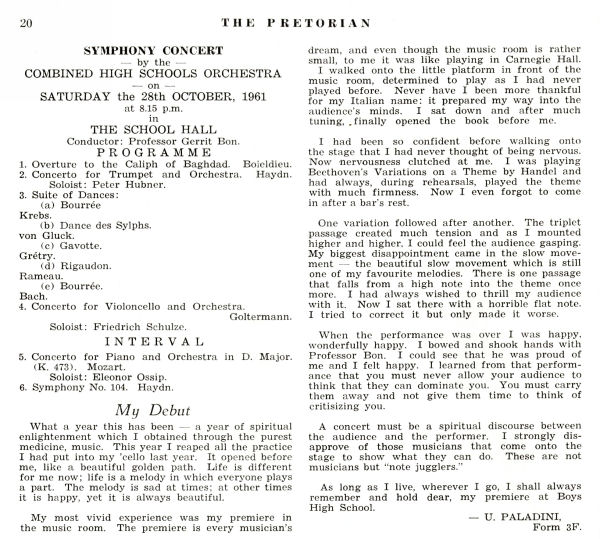
The first symphony concert I took part in was quite ambitious: Mozart’s Eine Kleine Nacht Musiek, Schumann’s Piano concerto in A minor and Beethoven’s Symphony No 8. Ambitious or not it left an indelible mark. Never do I hear those works without a deep sense of affection for the music and the memories they evoke. It gave us a sense of how works of that magnitude sound from the inside. The soloist, Hugh Evans, was held in awe by me: self assured and mature he handled everything he did with panache. He told me he had written a symphony and was used as an assistant repetiteur for choir practice.
What the concert sounded like God knows. Bon made up for the deficiencies in sound by the acrobatics of his conducting. I think it was a Walter Mitty moment for him – this was not the PHSCO before him, but the New York Phil or Amsterdam Concertgebow. Dressed in tails, his wispy hair flying, he conducted with verve, each gesture choreographed to give effect to how the music should sound.
Bon also conducted the choir. The four part harmony gave a boost to the otherwise monotonous belting out of hymns, at assembly and special occasions. He revived the old pump organ at the back of the hall: a junior boy would be detailed to do the pumping. The announcement of a hymn would be followed by the distinctive ka-doof ka-doof of the organ’s wooden pump going to work, then slowly the wail of the organ would insinuate itself into the hall and we would all launch into our respective parts. The sound of the organ would wax and wane as the poor boy’s efforts vacillated between enthusiasm and exhaustion. Bon would lean periodically to urge the boy on.
I took part in two more symphony concerts at the school: they were less ambitious than that first one – we never tackled a Beethoven symphony again. In 1961 Peter Hubner played two movements from Haydn’s concerto for Trumpet and orchestra and Friedrich Schulze a cello concerto by Goltermann. Eleanor Ossip a pupil of Professor Bon played a concerto for piano and orchestra by Mozart, (K450). The orchestra went for less ambitious stuff although we did play Symphony 104 by Joseph Haydn. In 1962 Basil Fernie took on Beethoven’s first piano concerto as soloist. An all rounder, he filled in as extra on the viola when not at the piano and was academically very gifted. Robert Scholtz played Purcell’s Trumpet Tune and air. By then however, the wheels were coming off and Bon’s star was on the wane. I arrived for my second break entertainment in the music room and found the door locked. Ted Jones took over the orchestra. 1962 was the last symphony concert I played in. In 1963 the hall was torn down – a sentimental occasion when we were all given time off to witness that venerable edifice’s last gasp. Bon was relegated to leading the second violins but he retained the direction of the choir.
The annual Gilbert and Sullivan operas were a Pretoria fixture and their production was the preserve of Ted Jones. It must have been a herculean task, from ordering the parts on time from the D’Oily Carte company in London, to getting costumes made, sets put together and singers chosen and rehearsed. As far as the sets were concerned their design and construction were supervised by no lesser luminaries than two of South Africa’s foremost artists Walter Battiss and Lawrence Scully. Imagine that!
Jones had a far more robust approach to getting boys to make music. I suppose he had fewer illusions of what we were capable of. He also conducted the Military Band, less cool than the Bugle Band, it was not a marching band, but it got some of us out of having to do cadets.
I participated in three operas: Ruddigore, (50 years Jubilee performance), Iolanthe and The Yeoman of the Guards. Ruddigore went down very well with senior boys posturing within gigantic picture frames as the ancestors of the house of Murgatroid, Iolanthe saw the rugger buggers of tomorrow sing such inanely camp lines as “We are dainty little fairies ever singing ever dancing!”.
Over and above these annual events there were odd musical interludes which must at times have taxed the boys’ patience. I remember playing a series of baroque suites for cello and recorder before an assembly of boys at what must have been the last day of term. Andre Jaquet was tall with a large frame and he played the recorder while I, short with a small frame played the cello. There was lots of cheering and laughing when we walked on. Urbane, suave and with impeccable manners, André went on to join the diplomatic corps I am told. He played the bassoon in the school orchestra and had a brilliant tenor voice which he used to good effect in the choir and opera.
A debate was arranged with Seuns Hoër. They insisted that the speeches be interspersed by short musical interludes. The event consequently went on forever and the thread of the argument was often lost. Boys from both schools played odd pieces. I remember a Chopin piece played beautifully by one of their contingent.
After a year at the school Bon decided to show what he had been up to during his tenure and decided to arrange a concert of his students. I had only been playing the cello for a year; instead of choosing a simple piece within my capabilities, Bon chose the Variations on a theme by Handel by Beethoven which is really a work for advanced and accomplished cellists. I plunged into the work with all the panache of my young naiveté. Bon had introduced me to the audience by announcing that I was about to display the beautiful sound of the school cello. Halfway through the piece I looked up and saw Abernethy holding a hand over his very red face and shaking uncontrollably. It must have been hilarious. I suppose one of the aspects that made the Boys’ High of my day such a special place was that you could live out your fantasies.
The school I remember was a place where honesty, decency and good manners were cultivated. It was an embryo where, protected from the vagaries beyond the dusty pine forests and the sports fields, the sonorous bell and the Edwardian buildings, these values could be nurtured. So when we went out into the world and met reality, we carried with us the memory and comfort that in a far away corner of our life we had known Camelot.
– Ugo Paladini (1963)
Part 3 of 3
KHETHANI HUBBART OLIPHANT (2015)

Khetani Hubbart Oliphant, the last born son of Anna Mmamphsika and Humphrey Oliphant, was born on the 15th of January 1997. Khetani’s schooling journey commenced at Waterkloof House Preparatory School (WHPS) for his primary years. Khetani then went to Pretoria Boys High School where he excelled in all spheres of his life. He started off his high school career in Rissik House and finished in Abernethy House. As an Old Boy of the class of 2015 and a prefect Khetani was loved by all his peers. Khetani engaged in a diverse range of activities; from leading war-cries on Saturday’s as an enthusiastic cheerleader, to acting in the annual school production or singing in the choir. Khetani was an avid basketball player who played for the first team and also played waterpolo in his earlier days.
Khetani then moved on with his tertiary education by studying a Business course through UNISA (which he obtained with distinction). Throughout his studies, he worked at Superdry stores in Sandton and Menlyn which gave him priceless knowledge and leadership skills. His hard work, dedication, diligence, ambition and passionate selfless attitude is what granted him his new career venture at OUTsurance. His radiant energy and enthusiasm was evident in his work and the sound impact he had on his colleagues.
Khetani’s gentle soul which touched several lives, and did so effortlessly, will be missed. Khetani’s final venture before the tragic car accident was his startup business called Economic Excellence Traders. It was here where he taught and equipped several individuals with the necessary skills to excel and effectively Trade in Forex.
We are now left behind with the memory of a young, strong and charismatic man who’s love for humanity was reflected in his interactions. A young man who gave nothing but his best and believed in achieving all his goals with grace-will be greatly missed. Khetani leaves behind his parents, sisters, brothers, nieces, girlfriend and friends. His legacy will never be forgotten and will be dearly missed and always loved.
“RIP Mbele, Mphembe, Khuboni, Langalokulunga. MaBhelamahle angafiyo abhubhayo abhubha xa ethandayo.”