
PBHSOB ASSOCIATION NEWSLETTER
Dear Old Boy
Thapelo Aphane attended Steyns’ Culinary School and did in-service training at the Mount Nelson Hotel in Cape Town after matriculating from Pretoria Boys’ High School in 2012.
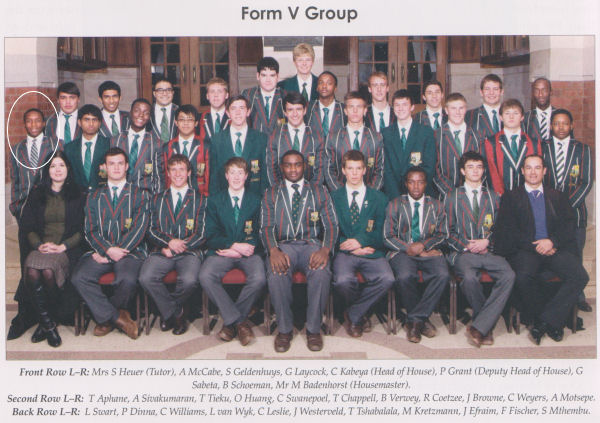
Thapelo was in Abernethy House and his favourite time of the year at school was when the Four Schools’ Concert took place and he thoroughly enjoyed the annual Maritzburg College exchanges. Thapelo also took part in “anything inter-house” received half colours for Choir and was a member of the Drama Club.
Thapelo says that almost all his teachers at Pretoria Boys High School inspired him in one way or another: “Mr Reeler taught me about resilience and integrity… I have carried those with me for a few years now… Mr MacDonald taught me about setting goals and I think I am perfecting that. Mr Badenhorst always pushed me to do my best no matter the cost; he said “keep your head up boytjie””
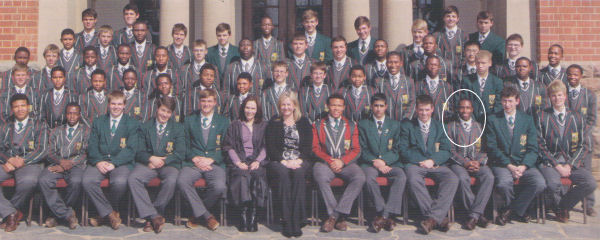
Pretoria Boys’ High School Choir 2012
“… Boys High certainly has something about it that one just cannot miss…
even four years after Matric, I can spot a Boys’ High Boy out of uniform,
anywhere in the world… they just have that one thing
that sets them apart from the rest.”
After school Thapelo qualified with a Diploma in Culinary Arts and Patisserie and says “I pride myself with a burning passion and desire to be the best in the world!” His career entails long hours, hard work and little to no sleep but as he says “That’s part of the package and why I love it!”
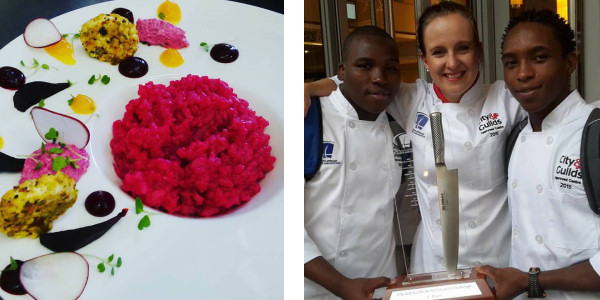
L: Thapelo’s Beetroot Risotto with Goats cheese, beetroot mousse, beetroot puree,
butternut puree, fresh radish and beetroot wedges. R: Competition Victory with the Knife “cup”
Thapelo won the Skilled Chefs’ Challenge 2015 and became a member of the Junior SA Culinary Team. He has been also appointed as the team’s first choice griller – which entails working with all the protein during the competition.

L: Thapelo holding a demo lamb cutlet plate at Cape Town Good Food
and Wine Show 2016. R: Junior SA Team at Cape Town Good Food and Wine Show 2016.
The Junior SA Culinary Team will be taking part in the 2016 IKA Culinary Olympics in Erfurt, Germany in October this year and Thapelo has been appointed Team Captain for the five-man team that will be representing South Africa.
MASTER’S INTERVIEW
PETER BANTOCK
A RARE AND SPLENDID SPIRIT WITH ENDEARING GOODNESS.
One person who inspired and uplifted many of the 1940s and 1950s generation at the School was Peter Bantock (87), the kind of person revered at educational institutions across the globe.
He faced major hurdles as an orphan, but went on to make enormous good as an educationist, husband, father and excellent sportsman. His courtesy, humour and interest in others all add up to an extremely attractive personality.
To his colleagues he seemed to have ‘just about all that it takes’ – a keen and scholarly brain, all the gifts of gamesmanship which appeal to boys, a fluency of speaking, and an easy approach to all who meet with him.
Peter taught variously at our School, Prince Edward in the former Southern Rhodesia, an Anglo American specialist school in Kitwe in the former Northern Rhodesia, and St Stithians in Johannesburg.
Leon Kok caught up with him at his home in Benoni.
Excerpts:
Tell us about your youth?
I was at an Anglican orphanage (St Martin’s Home) in Durban during most of my youth. Those, of course, were also the War Years. We had regular blackouts, we were rationed, and we had to eat every grain on our plates. We were told by the nuns, ‘If you don’t eat that food, the Germans will’. We were also warned that we needed to be careful because the Japanese were convoying just outside Durban.
How did you land up in an orphanage?
My father, a veteran of the Great War (WW1), was shell-shocked at a battle around the Belgian city of Ypres, and much later admitted to a mental home. My mother was unable to care for us. I was there from age 3 to age 14.
Of interest, five major battles took place around Ypres where the German and Allied armies clashed. In the first two there were more than 100 000 casualties each; 400 000-800 000 in the third battle; 100 000 in the fourth battle; and 10 000 in the fifth battle. German casualties were unknown.
Did you have any siblings?
Yes, my sister Penny (later Smith). She was placed in an orphanage in Maritzburg, of the same order of nuns as St Martin’s. Initially, we were placed with a family near Kokstad who ran a school farm. That, however, closed down, resulting in our being sent to the respective orphanages.
Were your parents married before or after the War?
After the War. They bought 13 farms in the Pietersburg district and I was born on one of those farms, ‘Sterkloop’. Interestingly, with a major shortage of water in the town at the time, its municipality drew all the water off Sterkloop, resulting in my father having to initiate court proceedings against it. The matter also contributed significantly to my father’s stress.
The matter was finally resolved by my godparents, Judge Nicholas de Wet and Mr Tom Naude. Judge de Wet eventually became the Chief Justice of South Africa and on occasion stood in as Governor-General. In fact, he was offered the position of Governor-General on several occasions, but refused.
A National Party politician, Tom Naude served as Acting President of South Africa in 1967 and 1968.
Did your father ever recover from the shellshock?
Yes, 50 years on, the mental home in Pietermaritzbug contacted me and said that for all intents and purposes he was well and it was time for him to be located elsewhere.
As a school master and with a family of five children at that point, this posed a major challenge. I wrote to the British Ministry of War and received a document confirming his distinguished military record, the medals he had won, and we took the matter from there. My father was awarded a War Veteran’s Pension and spent his remaining years in a Home in Edenvale.
And your mother?
Notice was received from her lawyers that she had died of Black Water Fever in the Cameroons.
How did you get to PBHS?
The nuns put out a message that there was a ‘deserving boy’ in need of an opportunity to get a matric at a good school, followed with a sound university education. Most boys at the orphanage were placed in a trade at around 14 years of age.
Among other places, the message was broadcast at the Theosophical Society in Pretoria. It was an organisation that had initially been established in America in 1875 by a non-sectarian body of seekers who aimed at promoting brotherhood and service to humanity.
At the meeting it was said, “If you know of anyone who may be able to assist, please let us know”. Initially, there was silence. Then an Angel, my future mother-in-law, Mary Eedes, put up her hand, and said, “I will take him’.
Extremely generous folk, she and my future father-in-law, John Roland Eedes (Rollo), had six children of their own. They lived in Lynnwood Road, which became my home. Rollo was a bank clerk who didn’t earn much, but they managed to make ends meet. Initially, I was placed in a tent in the garden, because one of the children had whooping cough.
Were those happy years?
Extremely so. I was well cared for, we had wonderful cricket matches on the property, and included many smaller kids who went on to make it really big. These included the likes of Eddie Barlow, Jackie Botton, Glen Hall, Syd Burke, the two Corbett brothers, the two Hector brothers and others.
Peter Corbett and his brother John were fellows who we knew well. Both were exceptional sportsmen, but Peter had a problem with maths. We met frequently to address this difficulty.
My wife Tem & John were key members of the PTA who had the Squash Courts built at the school.
Your first day at Boys High?
That was 1944, and I was enrolled into standard nine. I remember everyone was in khaki (informal dress) and I arrived wearing a white shirt and green jersey that I had especially knitted at the orphanage. I was so proud to be going to Boys’ High that I felt that I needed to be appropriately dressed.
But, as it turned out, I was wrongly dressed and stood out like a sore thumb, attracting numerous scornful looks.
You knitted!
Oh yes, we had been encouraged at the orphanage to knit socks for the servicemen. That was considered a very noble cause.
Your first Assembly?
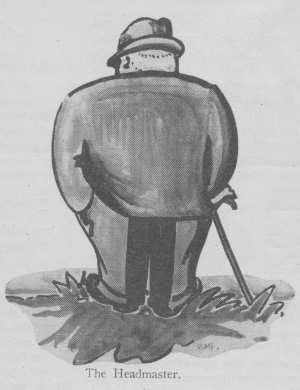
I was naturally impressed with the School’s beautiful estate and magnificent buildings. I was particularly overwhelmed by the grand hall. Dead silence arose when the Headmaster, Mr Matheson, mounted the stage, just as with the annual Remembrance Days. And then fidgeting with my hymn book, the silence was broken when the Headmaster looked at me and said, “Bantock, pay attention!”
This attracted yet more scornful looks, not least from the School’s biggest rogue, ‘Chappy’ Vlok, as if I didn’t understand its ethics and etiquette. His elder brother ‘Toppie’ and I became good friends and he later became a renowned Northern Transvaal rugby and cricket player.
On to class?
Naturally, quite an adjustment from where I had come. What I appreciated was that the School allowed you the freedom to choose and provided you with the capacity to make the right choice.
And that didn’t have to be about being an immature rebel or not, but of acquiring a true sense of values and of loyalty, knowing where you belonged, and having the humility and guts to get up and go there.
However, the first shock to me was my history teacher, Mr Kevin Wynne, who behaved as if he was on the parade ground. He lectured and spoke to you in a parade ground voice. I was terrified.
After the first lesson, I went to Mr Matheson’s office and said, “Sir, I’m frightened of the history teacher. Can I change to another subject”? Mr Matheson pointed out that history was mandatory, and then asked, “What do you fancy?” I didn’t really don’t know, so he suggested the history of art.
But there was no regular class scheduled, so I had to fit in with the general art lessons of several other classes. By the time we got to the preliminaries, I hadn’t had a single history of art lesson.
Prof. Walter Battiss then sat me down and asked me what I knew about art.
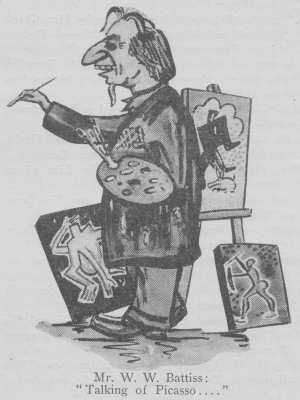
I replied ‘nothing’. He asked, “Have you heard of Michelangelo?” I replied, “Yes, vaguely. All that I know about him is that he famously did the ceiling paintings of Rome’s Sistine Chapel”. He said, “Go and write a piece on it and bring it to me”. I did just that, copiously including everything that I could. When he assessed it, he gave me 20/14.
I was useless at art, generally copied the work of RAM Edwards, and ended up with a B in my matric year.
Apart from Prof. Battiss, my art exposure brought me into contact with Clinton Harrop-Allin and Larry Scully. Clinton is an extraordinary scholar, and in my dining room I still have one of Larry’s pictures, originally acquired when I was a housemaster at School House. We were both housemasters at School House.
So what did you do when you matriculated?
Went on to Wits University, majoring in maths and applied maths. I had a student loan, stayed at the Knockando residence in Girton Road, Parktown; and made money on the side by teaching maths at the John Orr Technical School and the Witwatersrand Tech next to Park Station.
I also worked at the famous Johannesburg nightclub, Ciros, which was probably the hottest spot in SA at the time. It was known for its high quality food and leading vocalists such as Joe Kentridge, Bill Walker and Dan Hill and his band.
Post-university?
In 1950 I returned to Boys High. Three of us – Burridge Spies, Charlie Mulvenna and myself – had applied for jobs at the School, and were accepted.
Another PBHS contemporary of ours at JCE was John Stewart who ended up at Jameson High in Gatooma.
Recollections of teachers at the time?
I was housemaster at School House in the early 1950s, of which Noel Pollock was head, and Stuart Hendry the senior master. But we hardly saw Mr Pollock and he never engaged in the House per se.
The prefects were responsible for total discipline. When problems arose, they mostly consulted Stuart. Little came my way – I was the dog’s body with free board and lodging!
Bob Fair had been my English master in matric, and being the lazy guy that I was, I brought the house down on one occasion when he had ordered me to learn by heart 50 lines of poetry.
I chose an eight-line poem in which many of the lines were simply a repeat. Bob, with his excellent sense of humour, laughed as well.
‘Stokkies’ Joubert, head of Afrikaans, was a wonderful person too. At our final assembly in matric, he set up 5A to sing an Afrikaans song to the school (Hy kom van die kollege, dit is vakansie tyd) with each person singing one line and backed up by Syd Saks playing the piano. And when one guy slipped up at the end, Stokkies chipped in himself.
His son, Johan, became the Principal and Chancellor of the University of Pretoria.
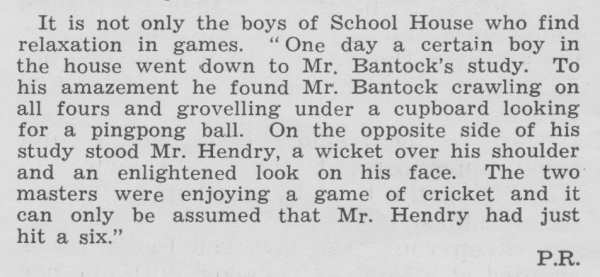
What was Burridge Spies like in those early days?
A good friend of mine, we were both in 5A. A very keen history scholar and a talented sportsman as well. He was cricket captain of North-Eastern Transvaal for many years. However, I can’t recall him having played for the Boys High 1st XI. His success was more a product of determination to do well than natural ability.
His mother was a teacher and came from Volksrust. Her maiden name was ‘Burridge’.
Larry Robertson?
A great guy who went on to become Progressive Party leader Jan Steytler’s righthand man and founded Capital College and Promat. Both were aimed at getting academically struggling kids through matric. I was on the board of Promat and was devastated when it was burnt down and destroyed.
Terry Ashton?
Terry Ashton certainly comes to mind. He started his career at Settlers (Lord Milner School) in the Northern Transvaal.
After graduating, Tem and I drove regularly in my 1934 Morris to visit him. In due course I persuaded Terry to move to Boys’ High, which he did.
We played lots of tennis together on Daniel Matheson’s (School House) tennis court. Also included was Val, Desmond Abernethy’s daughter.
What was Terry like as a young man?
Incredible. A legend, but arguably complex. He grew up in the Klerksdorp mining environment, was one of eight siblings, seven of whom were boys.
Terry had to carry much of the ongoing responsibility and acquitted himself extremely well.
He was head prefect at Klerksdorp High School; chairman of the Students Representative Council at JCE; and head of Knockando.
Terry never had a music lesson in his life but could sit down at the piano and literally play anything.
He had a good relationship with every boy that he taught. In spite of the typical boarding house challenges, he was always controlled and decent, and invariably defended those seriously in trouble. For instance, when there was a likelihood of a boy being expelled, he volunteered as the alternative to take him under his wing. In that way he saved the bacon of many who later went on to play significant roles in society.
Terry Mulvenna, also arguably eccentric and complex?
His brother Charlie was quite an effervescent figure at JCE, also active on the SRC and involved in Knockando’s affairs. Terry was different, a quiet sort of guy, but knew exactly what he wanted out of life.
He was keen on motor sport and was an avid CBCOB hockey player (having matriculated at CBC) whilst we played for PHSOB.
I often got a lift with him on his motorbike to Pretoria at weekends.
Other personalities of interest?
Yes, two superb sportsmen who have often been overlooked are Aubrey and Ray Burer, who were in a class of their own as swimmers at the School and became Springboks.
Aubrey, in fact, was the first South African to win a swimming scholarship to an American university (SMU) and captained the Springbok Swimming Team in the 1950s. At the recent Class of ’56 Reunion Aubrey had arrived from San Diego (USA) where he is now resident. We renewed acquaintance after 60 years.
When I joined IBM in 1966 Ray was my head of department and another of my contemporaries at Knockando, Jack Clark, was CEO of IBM at the time.
You bring to mind Terry Collard, the (1950s) school PT teacher?
Yes, he was apparently the first Springbok ever to win a silver medal at a major international swimming competition (the Empire Games in Australia in 1938). He lost gold to a Canadian by less than a split second.
Aubrey Burer however broke Terry’s 100 yds record while still a school boy.
Terry went to War in 1940, served throughout in North Africa, was wounded shortly before the end, and returned to SA and joined the PBHS staff.
Your marriage to your ‘adopted’ sister, Rosemary Joyce (Tem) Eedes?
Our relationship started when Tem was about six and I was about 15. When she was in her matric year she used to take dancing lessons every Friday night with the boarders at the School.
At that stage, however, I was already a ‘veteran’ but she had certainly caught my eye. I was already a housemaster at School House, having gone there straight from university.
And when I started taking Tem out, the boys shouted ‘Hi Tem’ and ‘Good evening Sir’ with much glee. Tem and your (Leon Kok’s) sister Gill were good friends and rode together to Pretoria Girls High every day.
Five years later (1955) Tem and I married and relocated to Rhodesia. Teachers pay in the Transvaal was pretty poor and in Rhodesia they were offering double that pay.
I might add that my pay at PBHS in those early years was £26 a month and on top of that I still had to pay off my university loan. So we didn’t have much to get married on and I joined Prince Edward School in Salisbury.
Why Prince Edward when you also had the choice of other wonderful schools in Rhodesia?
One reason was that I was recruited. Another was that it was so similar to Boys High. Besides, the Rugby Jerseys were identical and the 1st XV mascot was a ‘Tiger’. My Headmaster at the time was Jack Gaylard who was at Rhodes University with Prime Minister Ian Smith and later became Secretary of the Cabinet. Jack, of course, was well known to you too.
Sporting Alumni include Nick Price, Mark McNulty, Duncan Fletcher, Jackie du Preez and Tenderai Chavango of the Sharks. Ted Alexander and Ian Bond came close to selection for South Africa.
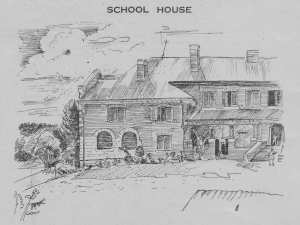
All our five kids were born in Salisbury and spent time on the campus and loved it. Our two boys, however, were later enrolled as boarders in School House at PBHS.
I recall Jack Gaylard telling me that Prince Edward’s motto was ‘Tot Facienda Parum Factum’ (So much to do, So little done). Cecil Rhodes words on his deathbed in Muizenburg in March 1902.
Indeed. Prince Edward was established in 1898 in Salisbury, as Salisbury Grammar. It was likely named after Prince Edward V111, who was Prince Edward at the time.
In 2002 the Zimbabwean Ministry of Education announced plans to change names of all government schools that had colonial connotations and that Prince Edward was set to be renamed Murenga Boys High, but this fell away.
Your later years?
These were spent on the Northern Rhodesian Copper Belt and back in Gauteng. A PBHS Old Boy, David Hagen, recruited me to the copper mines in Kitwe. He had been one of my pupils at PBHS – I taught him maths at the School. He was a ‘day boy’.
Tem and I decided in mid-1964 to move to the Copper Belt to assist Anglo American scholarship holders prepare for overseas universities. Of course, prominent PBHS Old Boy Murray Hofmeyr was deeply involved with Anglo American’s interests in Northern Rhodesia and that also inspired us.
Much of this, however, came unstuck with Zambian independence in 1964. One of my fellow squash mates who was manager of IBM in Zambia said to me one day, “Why don’t you move back to South Africa and join IBM?”
I followed up on the idea; joined IBM for 20 years; in 1986 had a hip replacement; and then decided to return to teaching. The educational legend Mark Henning offered me a job at St Stithians and I taught there for several years.
The worst part, because of the hip replacement, was that I couldn’t take sport and that really got to me.
Text: Leon Kok | Images: The Pretorian 1945, 1956, 1953
20 YEARS ON REUNION 2016
Everyone says it, ‘hard to believe it’s twenty years’, and then the day comes.
In our case the weekend started with an unofficial attendance of assembly. Boys High Old Boys being what they are there is always someone who has to ask what the dress code is, as if one can forget that it is always jacket and tie, at the very least. Then there is always one joker who has a quick retort, ‘Hawaiian’ and then there always has to be the one, who arrives in a colourful unsuited shirt. It is all good fun!
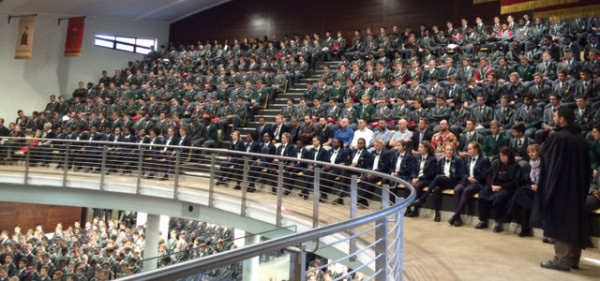
Two hours later, thirty odd chaps gathered at Wingate Golf Club for a round of golf remembered more for the guzzlers than for the approach shots. The joy of the occasion was not just having so many of the class swinging clubs, but being accompanied by Chalky Sommerville, who looked the only serious player in the field.
On the Friday night we wandered over to The Club, where about sixty odd souls, some partners in tow, gathered for a festive drink and a light meal. The joy of the occasion was the arrival of Mr and Mrs van den Aardweg, both of whom enjoyed the company of some they had not seen for two decades. As always, with the first night, there are those reckless chaps who forget that one never spends all your powder on the first engagement, better to keep a reserve store, nonetheless rumours abounded in the morning of their late morning finish.
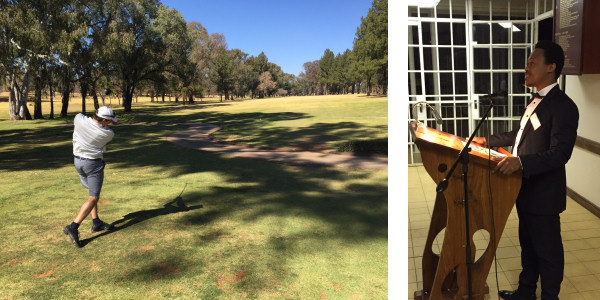
The rugby against the old enemy attracted a couple of chaps who’d found a bed in time to rise for the occasion.
At a little before six fully fifty guys in their ties, and one in the most colourful suit, actually I once saw a chap selling animal balloons in the very same suit in Bruges, gathered for a tour of the new hall and Bill Schroder Centre. It was simply astounding to see how much had changed and yet still how the character and so much stayed the same.
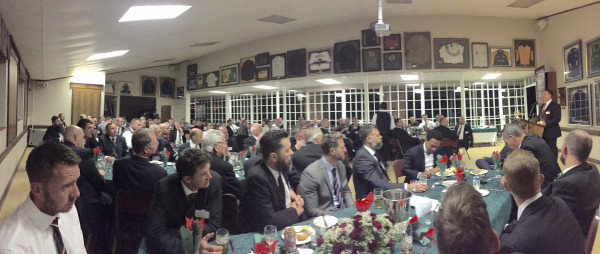
Formal proceedings began at seven, ninety folks sat down to dinner in the Sommerville Pavilion, and very quickly we were in full flight. Twenty years on it was great to hear the voices of Lincoln Keeton (now a master at the School), John Smit (Rugby player, administrator and singularly dedicated father), Darrin Lang (our unofficial ambassador to Italy), Emilio Eftychis (Architect, raconteur and general nice guy) and finally Kabelo Kekana (wizard and finance genius).
The crux of the Toast to the School, delivered by Kabelo, was about the values instilled in us, in every Boys High boy. It was about our duty to the School, and of the School to the country. Ultimately, it was a celebration of the brotherhood and the fabric that binds us all to one.
It was brilliant to hear from Mr Tony Reeler, giving us an update on things at the school. His reply was met with a rousing cheer.
It was, however, at the open mike that things were really moving. Besides the brief address by Mr Schroder (invited to reply to a comment made by one of the guys) it was Kenny Smith who stole the show. He had left Affies at the end of form I to start at PBHS in form II. His point was a simple but sincere thanks, not just to the headmaster for taking him in, but to all of us, for the friendships and support, for everything that made life rich and worth the distance.
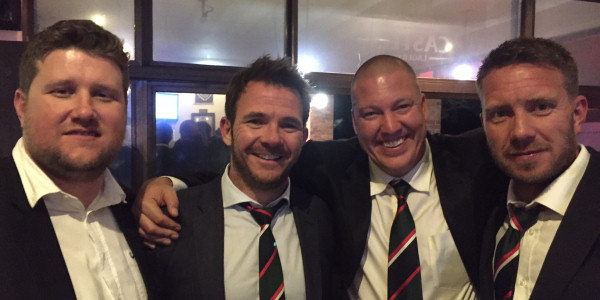
Rumour has it that the bar at the school only closed at one, that the last person out was a former headmaster and a present one, but I cannot confirm it.
At the Club, the lads celebrated an excellent weekend together, and when the first Lapwings roused in the early morning sun, the doors closed and the last few chaps headed off into the sunrise, ready for the next reunion.
Eugene Ashton
Convenor, Class of 1996
Images & Text: Eugene Ashton
PRETORIA BOYS HIGH SCHOOL NEWS
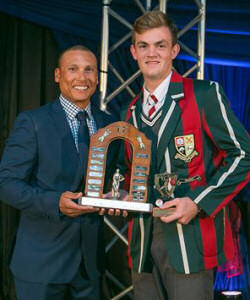
Congratulations to Chris Britz on receiving the U17 Northerns Cricket Player of the Year award.
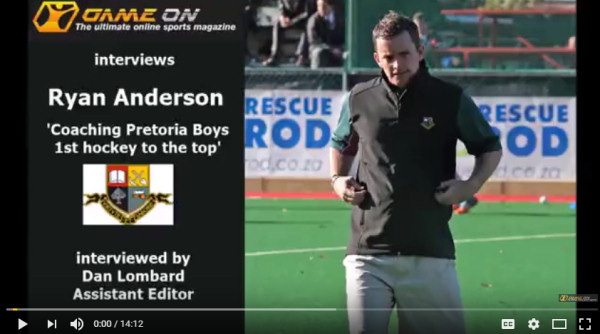
Click here to listen to an interview with the PBHS Director of Hockey, Mr Ryan Anderson in Game on Magazine, published on June 15, 2016.
Ryan Anderson joined Pretoria Boys as an accounting teacher and master in charge of hockey in January of this year. In just five short months he and his fellow coaches have taken Pretoria Boys hockey to the upper echelons of schoolboy hockey. Game On Magazine sat down with Ryan at the PBHS hockey astro to find out more about his coaching philosophy. Mr Anderson has also recently been appointed as Head Coach for SA Schools U18/B hockey team.
Images & Text: PBHS
MUSIC AND LIGHT SHOW
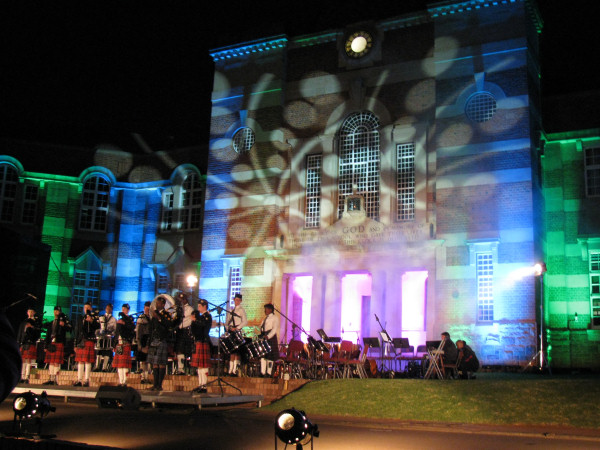
The Music Department of Pretoria Boys High School invites you to an enchanted evening with the School’s Orchestra and Choir. Enjoy a night of music and light featuring the Boys High Music Department and the school’s historic buildings.
Date: Friday 12 August 2016
Time: 17h30 for 18h00
Venue: Pretoria Boys High School
Cost: R100 per person
Tickets can be bought on-line via credit card from Tuesday 2 August 2016. Click here to purchase tickets online. For EFT or Direct Deposit, please e-mail support@tixsa.co.za for assistance. Ticket support number: 0722746241
SOCCER AT PRETORIA BOYS HIGH SCHOOL
Dear Parents/Guardians and Old Boys
SOCCER AT PBHS
The School Executive and School Governing Body have debated the issue of soccer as a school activity for some time now. For many years, the school has been asked to introduce soccer into the extra mural curriculum and we have discussed at great length what the potential impact this new activity would be. While there are compelling arguments on both sides, we have decided to introduce soccer as an extra mural activity in 2017 for a trial period of time (two years) and under certain conditions. The following will apply:
- The soccer season will be six weeks long and will take place during the last six weeks of the third term after the conclusion of the rugby and hockey season. This will enable us to play against our traditional rivals, almost all of whom play soccer at this time.
- We will have two teams per age group, U14, U15, U16 and U18 who will practise on Mulvenna field and play matches once per week by arrangement but not on Fridays to preserve our cultural time.
- The boys will play the sport the “Boys High way” and any poor behaviour will be dealt with as we would in any other sport. We are fully aware that soccer may have the reputation as being a sport where arguing with officials and excessive celebrating is acceptable but it will not be acceptable at PBHS.
- There will be no specific kit designed as yet and boys will play in existing sports kit for this trial period.
- All boys who would like to play soccer for the school teams MUST have played at least one of the five major team sports (Basketball, Cricket, Hockey, Rugby or Water Polo) and MUST be available for selection for the Athletics team if required at mass-participation meetings. Non-participation in these sports will disqualify the boy from playing soccer for the school.
- The school will provide coaching and equipment such as goals and balls.
- As this is defined as an activity not a sport as yet, no colours awards will be made.
- After two years, the school will reassess whether the activity has added educational value to the school or not and reserves the right to cease playing soccer or consider changing the status of soccer to a fully-fledged sport.
This is a significant step forward for our school and yet there will be some who are for the decision and some against. We would like to assure our community that we will ensure that soccer is only played against traditional opponents such as KES, Jeppe and Parktown, according to our expectations.
We anticipate this decision will result in greater participation by more boys in our extra mural programmes and should not result in a drop of numbers of those playing our existing sports as the activity will take place outside our regular seasons.
To those who are against the decision to play soccer we ask for your patience and understanding as we give this activity a chance. Boys High started off by having a few niche sports such as Rugby, Cricket and Athletics. In the same way as we introduced other sports to our school in the past such as Hockey in the 1950s, Water Polo in the 1970s, Basketball in the 1990s and the smaller sports such as Climbing, Table Tennis and Fencing, we are now looking to provide a relevant extra mural offering that caters to the needs of our broader community.
Boys High has always prided itself on being a dynamic organisation at the forefront of necessary and relevant change. There are so many activities at the school that didn’t exist in the past that have filled a need and given an opportunity to our boys. Let us embrace this change and move forward in our quest to provide the best educational offering for all our boys. Let us make this work for the benefit of our school in the future.
A D REELER
HEADMASTER
OLD BOYS IN THE NEWS

Appointment of Clyde MacDonald as Principal – Tyger Valley College
I am delighted to let you know that Clyde MacDonald (1991) has been appointed as Principal of Tyger Valley College, High School, effective from 1 October 2016.
Hilton College Announces George Harris as 17th Head
The Board of Governors at Hilton College is delighted to have appointed Mr George Harris (1988) as the School’s new Head from 1 January 2017.
Letter to the Community: New Headmaster
I am delighted to advise you that Mr Shane Kidwell (1987), the current Headmaster of Oakhill College, Knysna, has been appointed as the 6th Headmaster of St Alban’s College.

Julian Rademeyer fights to hack apart rhino poaching networks
Julian Rademeyer (1993) is one of the most authoritative voices on the seemingly irresolvable problem of the illegal trade in rhino horn.

Fish: We Can Mould Future National Superstars
Bafana Bafana legend Mark Fish (1991) has emphasised the importance for young South African women to reach for the sky, make use of the opportunity and to realise their dreams through this initiative.
Overseas Melton enjoying life at Sudbury
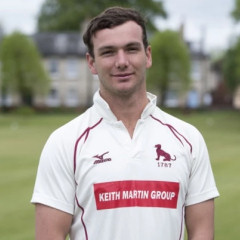
Dustin Melton (2014), Sudbury Cricket Club’s overseas player, is enjoying the challenge of East Anglian Premier League cricket, despite the recurrence of an old injury reducing the pace of his delivery.
10TH ANNUAL EASTERN CAPE DINNER
Held at the Kelway Hotel, Port Elizabeth on the 27th May 2016
It was in 2005 at a function in PE arranged by Bill Schroder and Directors of the Association, that Mark Muttitt offered to resuscitate a branch of the Association in Port Elizabeth. That branch is now 10 years old and meets regularly, including an Annual Dinner attended by the Headmaster.
One of our special guests that evening was Executive Director Geoff Meyer. Geoff, in the past 10 years has not missed one dinner! We much appreciate Geoff’s dedication to our region over this period.
Another guest was Canon Roy Snyman (1947) who did an opening prayer and grace for us, remembering Chris (Tos) du Toit, Dr Colin Lang of Knysna, Ross Op’t Hof son of Tony Op’t Hof and Mr Reeler’s mother, who all passed away this year. Dr. Langs father was Headmaster of Grey High School from 1928 – 1942 and taught at PBHS for a few years after his retirement from Grey. Ian Pringle, Executive manager of the Old Grey Union and his wife Pixie are regular attendees at our dinner.
The reason we call it an Eastern Cape Dinner is that Old Boys and their partners travel from all areas to attend. Peter and Dee Hollely travel from Knysna, Craig Williams from Plettenberg Bay, Glenn and Ann McCreath from Bathurst and Derek and April Green travel from East London (300Km).
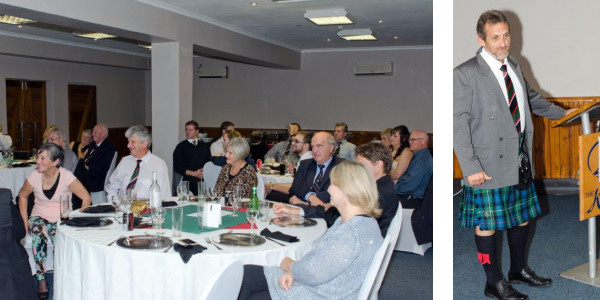
L: Group Photo, R: Alan Mackenzie in formal attire
It is always a pleasure to welcome Mr Reeler. He is always cheerful and remains positive throughout the difficulties presented to modern schools and their CEO’s. Andrew van Gruting proposed the toast to the school and in his response Mr Reeler reported on the excellent academic performance and good results in the various sporting codes. We are both aware of the difficulties being experienced by our rugby teams, and the efforts being undertaken to improve the situation. We believe this will be of short duration.
The opening of the Abernethy School Hall and the Bill Schroder Centre comprising of a music centre and library must make our facilities world class. We believe the Old Boys who contributed to make these projects a reality, are to be congratulated.
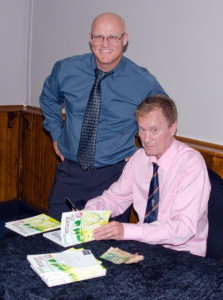
Mike Proctor- Sims has written a book “Give it horns, Boet” and used the dinner as an opportunity to sell some copies. Mr Reeler mentioned the cupboard in the library kept solely to house books penned by Old Boys. Canon Roy Snyman added to the collection by presenting Mr Reeler with a copy of his book “The Anglican Way” which has also been translated to Afrikaans
The Kelway Hotel once again provided excellent food and turnover in the Bar was at full steam. An excellent evening was enjoyed some adjourning to the Fariaghers Pub upstairs for a “one for the road”.
Images & Text: Vaughan Abernethy
NEW CRAZE
Once every nine months the school goes into a mad new craze. Twenty-seven months ago it was little spud guns which shot potato pieces. Eventually these were banned by the headmaster. The eighteen months ago it was the end of an era of the catties where the best shot ruled. After a boy was shot in the head by a cattie with a stone, the cattie was banned, and that era was over. Nine months ago the yo-yo came; hundreds of them were seen at school. Green, black, orange, pink, blue and many other colours were seen. I don’t know exactly what happened to the yo-yo but one day they were a swelling glory and the next day you could not see one around school.
But now we are in the present nine months and the “latest” seems to be writing on the desks in classrooms. Let us take a second last desk in the first row in Mr Hill’s class for an example. I sit there. When the beginning of the term dawned, the desk had nothing written on it.
But when you see it today you will see this:
Hi!
Next period, next person: Hi
First person: Don’t write on desks.
Second person: Look who’s talking.
First person: Who’re you
Second person: Wouldn’t you like to know.
And it goes on and on like this till the whole desk is virtually covered in writing. This is not the only desk in the class for there are many more. If you look closely at the old desks you might see old dates. The oldest date that I ever saw on a desk was 1937.
– L. Eerenstein Form 4G
(Taken from The Pretorian 1966)
ASSOCIATION OFFICE
Old Boys are advised that The Pretoria Boys High School Old Boys Association Office has recently moved from the PHSOB Club to the school.
The new contact number for the office is 012 460 2246 X200.
IN MEMORIAM
HUGO DURAND ACKERMANN (1954)
I have the sad task of letting you know that dad passed away suddenly on Friday, 8 July 2016. He leaves our mom, Ann and four daughters. Hugo was Head Boy at Boy’s High in 1954 and taught Maths and Latin at the school between about 1961 and 1971. He was a faithful Old Boy, in every way and was very involved with his Class of ’54.
Warm regards
Tracy (Ackermann) Symmonds
GEOFFREY MICHAEL WOODMAN (1962)
Geoff Woodman of the matric class of 1962 passed away at his hometown, Benoni, in June, following a courageous fight against cancer.
As a schoolboy, he lived in Albert Street, Waterkloof.
His wife, Jeanne, rightly recalled him as having had an amazing presence, was fun-loving and a force of life. His first love was for his family, and then in no particular order he loved aeroplanes, the bush, the sea and sport.
A good father and grandfather, he often joked with his family and without exception made time to interact with each and everyone, especially his grandchildren.
TUMELO SKOSANA (2008)
IAN MALCOLM HUNTER SCOTT (1944)
MICHAEL REG ENSLIN (1985)