
PBHSOB ASSOCIATION NEWSLETTER

The School House farm began with our new Senior House Master, Mr. Oldnall who had a vision to grow some vegetables. He contacted an Old Boy who could come and build us our happy, little vegetable patch. The Old Boy was more than happy enough to give us a discount and give back to the school; just like that, we had our first farm up and running. The word going around at the time was that the School House Boys had become farmers. We were doing something that had never been done before in school, but we wanted more.
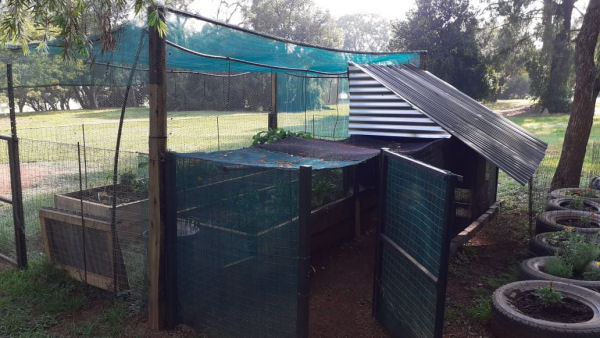
Once we got our first garden up and running, we saw that the demand for fresh produce was greater than what we could harvest from our small garden. This was when we were contacted by Chamberlain’s Hardware. We prepared a presentation explaining what our idea was and what we needed for the second garden. Chamberlain’s was impressed with what we came up with and said that they would donate all of the necessary materials for the bigger garden. Upon the second garden’s completion, more parents of current boys in the house got involved and donated various trees and an irrigation system to help improve our overall farm.

Our main goal with the farm is to avoid weekend gatings, where boys would have to stay in on the weekend because they accumulated too many punishments within a week, now boys who have to sacrifice their precious weekend with their families, can serve the house by working off their gating on the farm. However, when no boys have been gated within a week, the Form II’s would take charge on a rotating schedule to feed the chickens, clean the coop, water the plants and harvest the week’s yield on Thursdays. When this has been done, the Form III’s must sell the produce on Friday afternoons to parents, staff and guests. We are also in partnership with the restaurant ‘Toast’ to whom we sell a portion of our week’s yield.
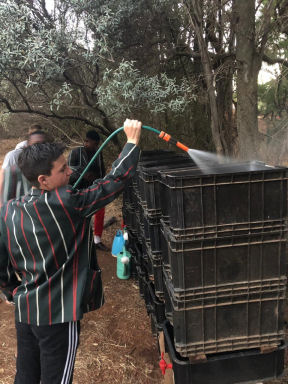
As well as our vegetable garden and chicken coop, we have our worm farm that was started by one of the boys. This converts organic waste into nutrient-rich soil for our garden. It also creates a product known as worm tea that is diluted and poured into the soil every Wednesday.
Overall, having the farm has been and also will continue to be a very valuable learning experience for the boys in the house as it teaches them responsibility, how to handle small scale agricultural projects and small scale animal husbandry. All income that is generated from the farm is put back into the house to improve and expand our variety of facilities and projects that are currently unannounced. Written for the Association Newsletter by: Sebastian Van Wijk, Joshua Le Roux, David Diemont and Kegan McIntosh (All Form III – School House)

4TH ANNUAL CHESA NYAMA

Old Boys are invited to the 4th Annual Old Boys Chesa Nyama on Saturday 7 March 2020. Any Old Boys who want to assist or DJ on the day must please contact the Association Office: info@pbhsob.com
Click here to make a booking We are looking forward to a wonderful turnout of Old Boys!
SUMMER SPORTS DAY 2020
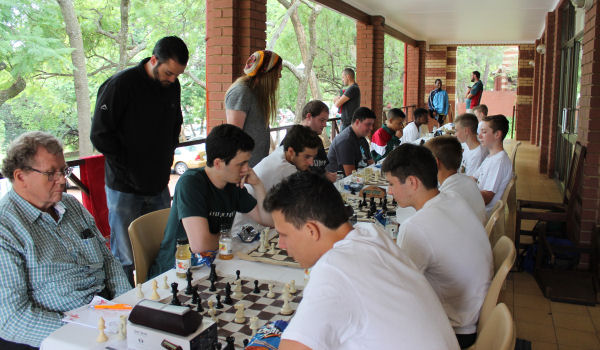
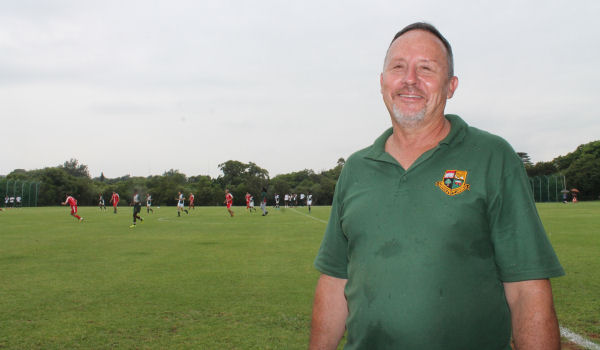
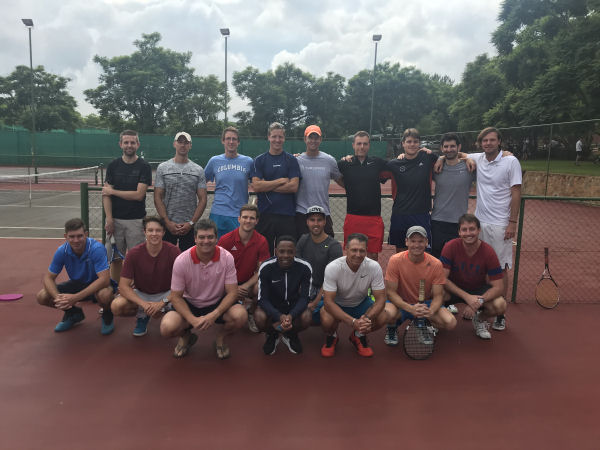
Summer Sports Day took place on 18 January 2020. Despite the weather a great morning was had by both Old Boys and current PBHS pupils. Most matches were rained out therefore a limited number of results are available, which can be viewed on the Association website.


APPEAL
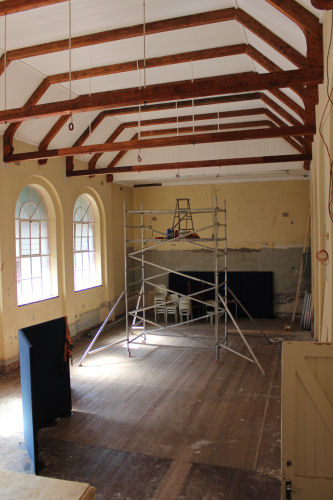
APPEAL FOR TIMBER NEEDED FOR RESTORATION OF HISTORIC ROOM
been made to the fittings and finishes and the restoration programme is thus an extensive exercise which requires a large quantity of replacement wood, particularly for the paneling of the walls.
A limited budget has been set aside for this project, mainly from a grant extended by the Pretorian Trust and donations from Old Boy reunion groups. However, we are currently experiencing a major problem in trying to secure affordable timber, even from stocks of recycled wood. We are therefore hoping that an Old Boy may know of a quantity of old Oregon Pine or similar (ideally planks of 1.3 metre or longer) which could be purchased for an affordable amount or obtained as a donation. Any leads in this regard, even if it involves a small quantity, would be much appreciated. If you are able to assist us in this matter, please contact Mr Illsley: 012 460 2246 ext 140 or john@boyshigh.com
MR BENIC’S BLUNDER OF 1980
This incident took place at the 1980 Matric Dance. Karen and I were hacking our way through a delicate waltz when Mr Benic and his wife came dancing our way. Boris smiled that smile you so often see on a chimpanzee and gave one of those winks he is so well known for. He said “Brewer! Is this the young lady you chat up at the gate every morning?” It took me a while to realise the full impact of what he’d asked. When I did, I realised that Karen too must have heard and I managed to stammer: “No, Sir”. Mrs Benic burst out laughing while Boris turning redder, departed rather hastily and apologised.
David Brewer VC – The Pretorian 1980
PBHS IN SOCIAL MEDIA
Taken from Facebook:
“You know how when you go to your son’s school for an event; parent teacher evening or a gala, maybe registration?
It all looks perfect. You see all the things they want you to see, traditions, sport etc.
Today, I was there just picking up stationery, during school hours, when they were doing what they do every day and I witnessed something extraordinary.
There was a small Form I child, day two in a new school, glasses too big for his face and traumatised, because he didn’t know how to tie his tie.
He was in tears and out of the blue, a large senior put his arm around his tiny shoulders, guided him aside where none of his classmates could witness his embarrassment and he carefully taught him how to knot it.
I had to put my sunglasses on to hide the tears and the fact that my son’s school is really the place where I want him to learn to be a good man.” – January 16 2020
TUCK SHOP TRIVIA
- Approximately 30 mothers help at the tuck-shop
- The tuck-shop has 18 regular suppliers.
- Pizzas and pepper steak pies are the most popular items
- Fresh fruit has never successfully sold at the tuck-shop
- Mrs Venn is also responsible for all the catering at sports events and cultural events.
According to Mrs Venn:
– Her funniest moment in the tuck-shop was when a pizza caught alight in the oven and a mother attempted to extinguish the fire by jumping on it.
– she likes working at the tuck-shop because there is a friendly atmosphere – it feels like one big family.
– she hates pouring tea in the middle of winter at evening functions such as the productions.
– the sale of slap chips on Fridays is very popular
– the most popular beverage should be fresh fruit juice, unfortunately it is Coca-Cola.
– the boys are generally well-mannered, except on civvies days. It is as if not being in uniform makes the boys “a bit silly”.
Yuan-Chih Yen & Keith Kichenbrand – Boy’s Highlights. Number 14, May 2000
LETTERS
MUSIC AT PRETORIA BOYS’ HIGH
(Reflections on a time long gone!)
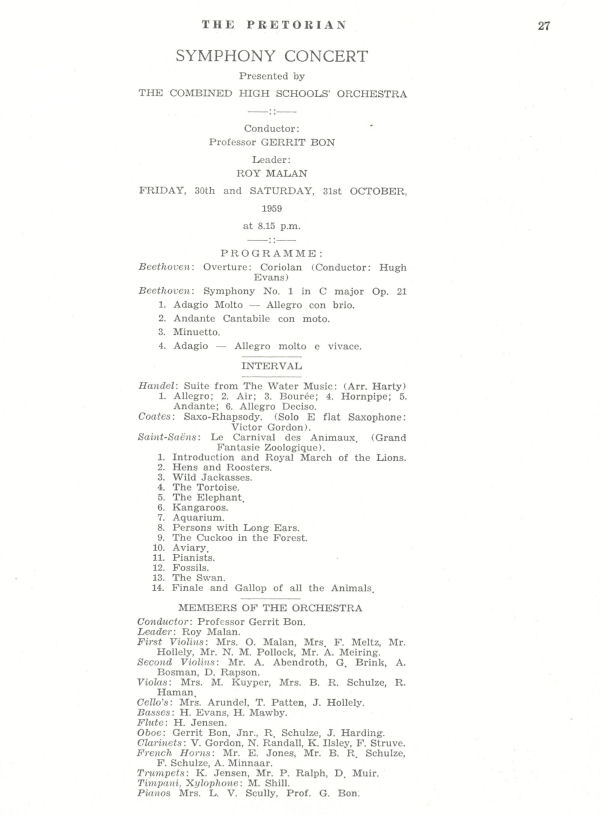
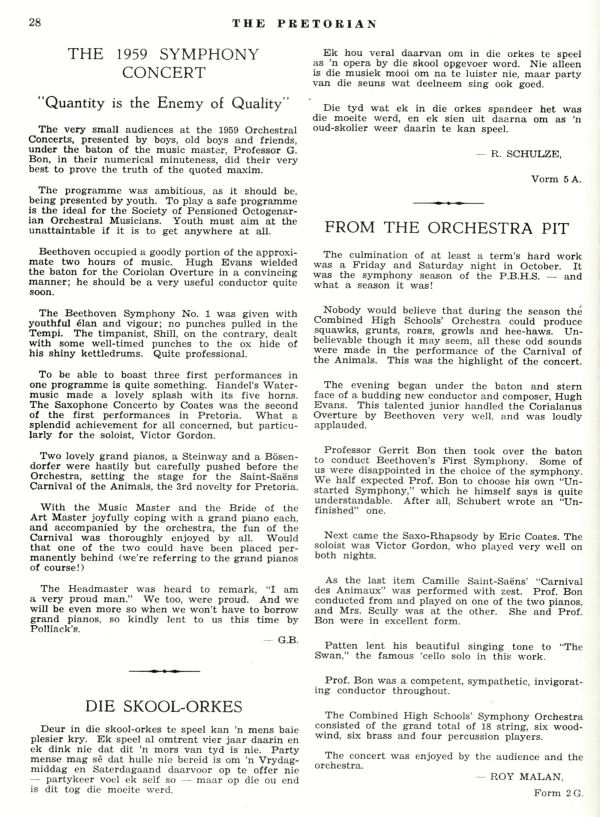
I came to Pretoria Boys’ High in 1959 and as I write this it seems a preposterously long time ago. To preface the year with 19 is bad enough but to then follow it with a five is positively alarming. There are few experiences in life that cause one to feel so insignificant as that first week in form one, as it was then known, coming into established hierarchies, traditions, and customs of which one knows nothing. Coming as I did from an Italian home, you can well imagine how alien it all seemed. To the headmaster’s credit, he interviewed each one of us, in his office, wanting to know who we where and were we came from.
In those days the aim of education was to turn out rounded individuals and to that purpose we were offered a weekly Music Appreciation class and an Art Appreciation class. To most it was a welcome break from the rigours of the “harder” subjects, to some it was the stuff of life. We had some wonderfully talented boys: artists and musicians.
My first year coincided with the arrival of Professor Gerrit Bon at the school as music master. A renowned organist, pianist and composer, he was tasked with the formation of a school orchestra and the teaching of music to matric level. He had made his reputation in the old Pretoria of the thirties and forties and claimed fierce allegiance to the old order – Smuts’ United Party
I was confronted, during my first lesson with him, by a shortish older man wearing spats and speaking with a heavy Dutch accent. He outlined his plan to form an orchestra and called for volunteers. Extraordinary how demotic and open he was to all comers: he neither tested us nor tried to establish whether we had any talent – if we wanted to make music, he would make it possible. At the time I was particularly concerned about gaining skills that would endear me to the fairer sex and thought that being able to play the guitar was a prerequisite to success. When Bon called for volunteers I got up and walked to the front determined to ask him for guitar lessons; but as I came nearer I demurred – how could I possibly ask this illustrious man to teach me the guitar, that folk-singer’s tool. So I said, “An instrument.”. He was delighted and suggested the violin. But that, I thought for some reason, was a girl’s instrument. “Well then what about the cello? Think about it and come back to me” he said.
I went home and asked my mother what is a cello. Ah she said, the instrument that most resembles the human voice. We had a stack of 78 rpm records we brought to South Africa and a wind-up gramophone. I heard the sonorous sound of the cello for the first time, through the hiss and crackle of an old 78: The Swan, played by William Squire.
I went to Bon and told him that cello it would be. The music room in those days was situated on the Solomon House side of the school building. It had a bohemian feel about it – instruments all over the place and a smell – a special musty/acrid smell that characterised the magic of what it entailed for me. Bon handed me a cello in a mangy canvas bag and a method by Alfredo Piatti, a renown virtuoso and pedagogue of the 19th century. And so began my long love affair. I took the instrument home filled with wonder, unpacked it, breathed in the smell of the music room and made the first scratchy sounds.
I was clearly unable to play in the orchestra during my first year but heard what was then known as The PBHS Combined School Orchestra from the audience. The orchestra was led that year by the then wunderkind, Roy Malan, a child prodigy who left South Africa and went on to make a career in the United States. Bon used to supplement the orchestra with professionals from the SABC orchestra. His son, an Old Boy, also called Gerrit was a superb oboist. He often filled in as principal oboe and brought along his friend Jos de Groen, a legendary bassoonist, to fill the first bassoon desk. Gerrit Jnr’s engagement was announced the night of that first concert I attended. All heads turned when his beautiful fiancé Margie entered the hall.
It was a wonderful idea to make it possible for boys to rub shoulders with professional musicians; it gave us an opportunity to gain insight into the craft of orchestral playing and to witness the sure footedness with which they played their part.
Bon would come to our flat in Jeppe Street, once a week in his DKW come rain or sunshine, to give me a forty minute cello lesson. When the Piatti exercises became deadly, he wrote popular Italian songs for me to play in the first position. I played on naked gut strings. I could not afford the aluminium on gut and he considered steel strings a modern abomination. So you can imagine what my poor parents had to put up with. I can still hear my mother crying, “Basta Ugo! Enough now!”.
There
were two breaks, a short break early in the morning, which all teachers were
obliged to attend and which the head-master used to make announcements and
communicate with his staff and a second break that was longer and used by Bon
to hold court in the music room. All were welcome. He would tell stories of
music in the old Pretoria, anecdotes of musicians and composers and generally
immerse us in the, to us, arcane world he had known.
– Ugo Paladini (1963)
Part 1 of 3
IN MEMORIAM
STANLEY LOUDON BROWN (1957)
Stanley Loudon Brown passed away in Tauranga, New Zealand, on Sunday December 7 2019 following a visit to SA to meet with close family and friends and to arrange for the publication of his excellent book Bowls, The Pathway to Success and Excellence.
Born in Krugersdorp in 1940, he grew up in Cullinan, was an outstanding sportsman, matriculated at PBHS in 1958, went on to become a formidable educator and sports administrator, was a coach of international note, and would have celebrated his 80th birthday on July 18 this year. His passing came on very suddenly, the cause an undetected abdominal cancer.Read More >>
ANDREW GORDON LOUGHOR-CLARKE (1958)
PETER CAMPBELL THOMPSON (1955)
GERALD SACHS (1957)
ERROLL CUTHBERT (1956)
DEREK JOHN DRAKE (1951)