
PBHSOB ASSOCIATION NEWSLETTER
REUNION NEWS
THE CLASS OF 1962 REUNION, 13 May 2022
Dear Friends
The county is currently passing through difficult and challenging times, we’re all in a steep learning curve, and education is key. Be that as it may, PBHS seems to achieve ever better results in the academic, sports and cultural arenas with each succeeding year.
No less commendable has been its obvious cultivation in each pupil of a sense of one’s own dignity and of deep understanding and respect for the dignity of others. In fact, PBHS is a shining light compared to several other schools that are currently scourged by delinquent and racist behavior, including attacks on teachers and other pupils.
All this was again visibly discernable at both the splendid combined ‘60-years-on reunion’ of the Classes of 1960 and 1961 a year ago, and the Class of 1962’s celebration on May 13. Both were incredible.
Said former Headmaster, Mr Bill Schroder, of the latter: “All the reunions have a uniqueness of their own but I can honestly say that this is one of the best and happiest of the many I have attended over the years”.
The main driver of this year’s event was Donald Jones and his wife Jackie. An old hand at it, he was involved with the School House 75 and 100 year reunions in 1989 and 2014 respectively, and various Class reunions thereafter.
Donald’s underpinning the School ethos and culture didn’t go unnoticed and was lauded by all. Remarked one Old Boy: “Even when the going gets tough, Donald exudes an astonishing attitude”. Not restricted to Boys High alone, his similar untiring involvements at St Dunstan’s Memorial Diocesan School in Benoni are renowned across the East Rand.
Special guests at the reunion included Messrs Eddie Green, Clinton Harrop-Allin, Greg Hassenkamp, Bill Schroder and his daughter Tracey Housden, and Tony and Phyllis Wilkes. Sadly, Mr Harrop-Allin, suffered a nasty fall at the conclusion of the day’s events.
Heavy Toll
Of the Class of 62’s 123 pupils, approximately 30 turned up for the occasion, some accompanied by wives, partners and family members. Sadly, 48 had already deceased. Former Class member, Michael Theron, paid tribute to them at the School Assembly.
One exception, perhaps, was Michael Bekker of Rissik House who died tragically in the surf off the Wildness in 1960. The incident was witnessed by his sister, ‘Muffin’, and classmate Alan Cave. Michael’s grandfather, Simon Bekker, was Administrator of the Transvaal in the mid-1930s and intimately involved with the School; and his father, Judge Simon (‘Tos’) Bekker was on the Bench during the famous ‘Treason Trial’ that commenced in 1956.
The majority of the ‘62 class were born at the cusp of WW11, between 1943 and 1945. It largely represented the turning tide when General Montgomery’s Eighth Army defeated Rommel’s forces at El Alamein; SA General Dan Pienaar’s men were in the forefront of the advance; and Tobruk was recaptured. The retreat by the Afrika Korps and German surrender in North Africa took place in May 1943.
A year earlier (29 June1942) the front-page of the Rand Daily Mail had screamed ‘7000 Recruits needed’. Said General Smuts, “They have to be found. We cannot let our Army down. Are we going to respond? Or are we going to play? Or are we going to sit back and nurse our wounds? I have no doubt what the response will be. A call from Libya. A call from Tobruk?”
Several of the Class of ’62 fathers, uncles and other relations were involved.
In fact, both regimes of Messrs Billy Hofmeyr and Daniel Matheson were overcast by the ravages of war, and WWII especially exacted a heavy toll among Old Boys who in peace and war had served SA well. The School lost 93. School enrolment at that point was around 700. Sons of the School had made an inestimable contribution to Southern Africa and the Allies as a whole.
A prominent player in North Africa’s unfolding events was SA’s ‘Uncle George Brink’ who was related by marriage to Mr Matheson and who consistently maintained a keen interest in the School. In the early war years he commanded the 1st South African Division in East Africa and later the Western Desert Campaign in North Africa. He died in Port Shepstone in April 1971.
Wrote the late Carel Birkby in his biography (1987) on ‘Uncle George’: “His own grave there is far from his fellow countrymen and followers who fell on many battlefields. His epitaph should be the simple words, ‘Uncle George’.
School Assembly
The Reunion followed the traditional format: meeting at 9 am on the Solomon House lawn for tea and coffee; a walk around the grounds led by the Headmaster, Mr Greg Hassenkamp; a visit to the School Museum; tea and coffee at the Bill Schroder Centre on the upper levels adjoining the Library; followed by attendance of the Friday School Assembly. The Lunch was held at the Old Boys Club.

Guest speaker at the Assembly was 1962 Head Prefect, Tom Brown, who boasted a proud sporting record and became a prominent KZN educationist. His achievements at the School alone included playing 1st team rugby for three years (1960-1962) and captain in 1962; playing 1st team cricket over the same period; and playing Nuffield Cricket (now Coca Cola Week) in the 1961 and 1962 tournaments. He was subsequently elected ‘Sportsman of the Year’ at the Air Force Gymnasium in Pretoria.
The thrust of Tom’s address was the importance of ‘passion and support systems at schools’, including the likes of family, friends, coaches and mentors, and the binding of these elements into the achievements of individual dreams and goals.
“To get support you need to be a good human being and get woven into the fabric of those who trust and support you”, he told his audience. “John Smit and Bakkies Botha were of this belief and spoke of the essence of menslikheid – good human beings”.
On the standing of the ‘Unknown Boy’ coined by former Headmaster, Mr Desmond Abernethy in 1960, Tom quoted the latter as saying: “He goes through school unhonoured and unsung but is the real backbone of the school in which an ordinary South African boy can feel at home. He is said to be better hardworking than lazy; kindly than cruel; brave than cowardly; compassionate than cold; considerate than selfish; and courteous than uncouth. In other words a true gentleman or lady – a good human being!”
Addressing himself especially to the boys, Tom added, “Your lives will evolve as you grow as a person. You will have to learn the art of adaption. An important attribute required in any environment is a fast-paced world. Adaptability is a great quality as is willingness to learn, work, strive (without expectation or entitlement), and be the best human you can be”.

A marvelous addition to the traditional line-up of awards at the Assembly was for ball-room dancing that had included competitions between boys partnered by their mothers. Dancing’s significance, of course, is that it imbues self-confidence among young people, creative thinking, spatial relationships and encourages the mastery of new goals. It also inspires young people to be part of something bigger than themselves.
Lest it be overlooked, Dancing at the School is far from new. This account from School House’s Archive:
Naturally, the House has always exuded fun, and no less so with the House dances. They were the rage from the very outset. Favourite dances in the 1920s were the Charleston rock steps such as the Hully Gully, the Watusi and Mashed Potato.
In 1936 it was recorded that excellent music was provided by Zulch and his Band, while supper under the Jacarandas was a feature of the evening. Even the ‘Bachelors Table’ had to give in before they conquered the spread set before them.
Several members of Staff were invited and although having brought only one or two partners between them, they wrought havoc in the Paul Jones and Tap dances. We appreciated their readiness to assist us in the matter of transport.
Graham Hearn conducted the Scripture Reading, PHILIPPIANS 4 VERSES 4-8.
The Assembly concluded with the singing of Forty Years On.
As an aside, the official School song, Tis Here We Learn to Live, was written in the 1930s by two Old Boys. Its composer, George Findlay, was a prominent Pretoria dermatologist. However, the School later adopted Forty Years On, originally the school song of Harrow School in London. And it’s this song that’s sung at most major PBHS valedictions and functions.
School House salute
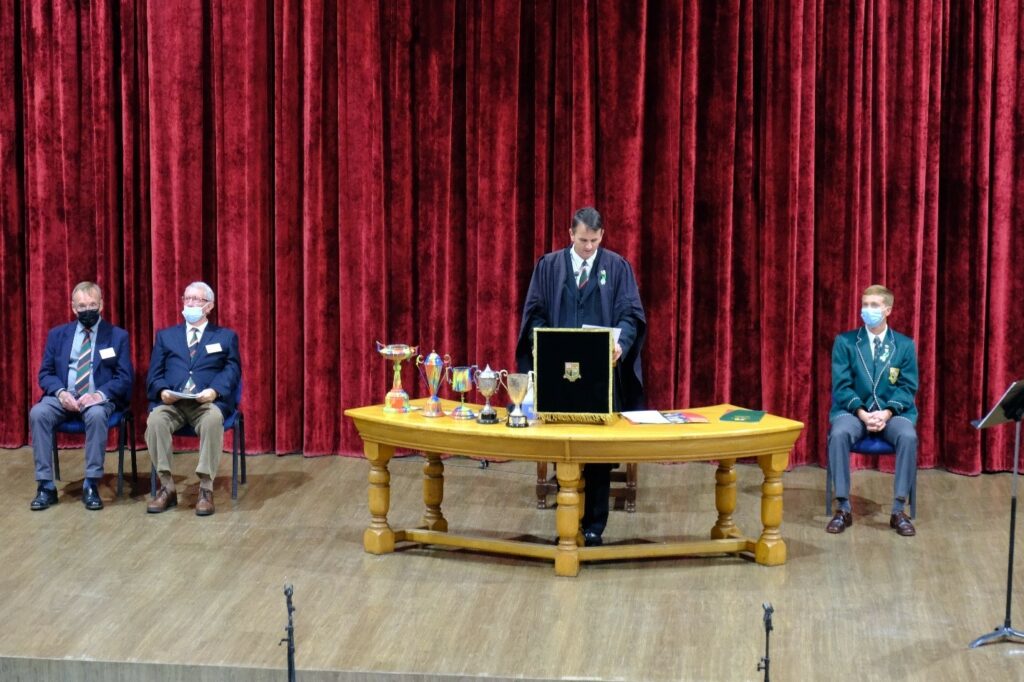
Old Boys of the House who had earlier broken away from the walk through school grounds, met at their former House with the current Senior Housemaster, Mr Chris Oldnall, the School Head Prefect, Joshua le Roux, Head of House David Diemont, and and Jaydon Knott Craig a very promising young cricketer.
Donald Jones account:
House Old Boys attending were Alan Stillwell, Tom Brown and his daughter Bronwen, Peter Marias and his wife Di, Donald Jones and his wife Jackie, Leon Kok and also in attendance were Greg and Lynn Grobler.
The House Boys were each presented with the 75th Anniversary School House tie and Chris Oldnall with a Centenary tie. All three were delighted to receive the memorabilia and Chris Oldnall’s tie was still in its wrapper.
Chris spoke with great enthusiasm about the developments over many years; Josh was eloquent in his thanks; and Jayden was ‘stoked’ as his father explained later.
The ties were really a symbol of what School House meant to the Old Boys, stood for, and the friendships that we forged and a reverend reminder of those who were no longer with us and countless others over the 108 year period since the establishment of School House.
Then a walk into the House itself and the reminiscing began! Do you remember? Blanket tossing, the termly pill administered to the new boys, laced with Brasso, polish and other ingredients, running the gauntlet, the Headwaiter Jacob shouting ‘put away your washing’, ’ time gentlemen time’ called by the new boys when waking the seniors in the morning, Patrick Stilwell’s announcement that World War 3 was about to begin because of the Cuban crisis in 1962, the Senior Housemaster Tommy Bourquin (past Headmaster of Sandown High and Dainfern College) at prayer time in the prep room saying, ‘Dear God please help us all from being so utterly useless’, then closing the Prayer Book and leaving the prep room boys stunned and speechless!
And so it continued and the questions flowed from the boys. They were impeccable in their manners and their behaviour and acted as great ambassadors for School House and Boy’s High. And so to the Media Centre for refreshments before attending Assembly.
Post lunch addresses
The main speakers at the Old Boys Club were the Headmaster Mr Hassenkamp and Mr Schroder. Both, by their own admissions, spoke off the cuff. The latter recounted his position as Headmaster of Hermanus High School and his subsequent appointment to his current post, and his meeting in the Karoo with former Headmaster, Mr Tony Reeler.
“In 2019 my wife, Amanda, and I brought up our daughter, Megan, to play netball in Gauteng and I recall our saying, ‘We can’t wait to get back to the beautiful Western Cape’. A year later, I received a message that Mr Reeler had resigned, triggering a major rethink if I was to be offered the post.
“True, Hermanus had been good to us. The school was also an excellent one. But I also knew that I wouldn’t finish my teaching career there. I had always been keen to land up as head of an all-boys school. And I also knew that my original duration at Boys High had merely been a stepping stone”.
He stressed, however, that he’d gone down to HHS School to establish the very best of schools in the Cape. “That was my goal. End of story. I never had an ulterior plan in mind. And I never had any other goal. I did my very best and don’t regret having spent seven very happy years in the Cape”.
Kudos to Hermanus itself, HHS and Mr Hassenkamp’s former status, the coastal resort today has grown beyond a back wood and has emerged into a new wealth hotspot with accompanying shifts in demographics, home-buying patterns, spending and investment. Much of this has been underpinned by ‘semigration’ from the north. Wealth growth in Hermanus grew at 32% in the decade to 2012, according to the Africa Wealth Report 2022.
Change of track
“We were watching hockey in Hermanus”, Mr Hassenkamp recounted, “when we received a message from my Deputy, Craig McBride, advising us that Mr Reeler had resigned.
“That’s all it said. I grabbed my phone to confirm the situation and remember not knowing whether I ought to be happy or excited. In due course, however, the headmastership at PBHS was bravely offered to me by the Governing Body.
“As a family”, he added, “We agreed that we’d had a wonderful seven years in Hermanus. But I also recognized that the appointment at Boys’ High might only come once in a lifetime. It would have been crazy for me not to have known that”.
Amidst the initial ambiguity in the Hassenkamp household, son Robert, then in Std 6, bellowed: “What are you all talking about? Obviously we need to go back to Gauteng. And, if you’re not going back, I’m going to do so myself. Sort yourselves out!”
Robert, Mr Hassenkamp explained, had grown up next to the boys in Solomon House, and it was the place that he wanted to be. “It was in his blood, it was in my blood, and that more or less settled it”.
Mr Hassenkamp had previously taught at Boys High between 1999 and 2013 where he taught Geography, was the Master in Charge of Rugby, and later settled in Solomon House as the Senior Boarding Housemaster.
Reaction in the coastal village, he recounted, was, “Greg, you have the magnificence of the Western Cape here. Why would you want to return to a dreary Gauteng? You’re mad! We look forward to when sanity returns and your returning to where we believe you belong!
“But what those folk didn’t understand”, the Headmaster explained, “was that I was not headed for Pretoria, but PBHS, and there is a very big difference between the two. And if you’ve never had a similar experience, you’d never understand it”.
On their final journey to Gauteng the Hassenkamp family met with Mr Reeler’s family who were heading in the opposite direction, somewhere in the Karoo.
Mr Hassenkamp recounted, “I had a caravan that I was pulling. We saw each other coming and we pulled over and chatted. It was a really cold morning, but special. Mr Reeler handed me a scroll, it was sealed, it had a stamp on it, and he said to me, ‘you can open it when you get to Pretoria’. It comprised the School prayer and a short message wishing me well. I was very moved by it’.
One of the best in the world
Mr Hassenkamp said that ultimately he was delighted to be back in Pretoria and it soon became evident to him that PBHS was one of the best of its kind in the world. This was further underpinned in a major international survey by the International Boys’ School Coalition (ISBC) in SA of which Boys’ High is a member.
It’s a dedicated non-profit organization aimed at enhancing the education, well-being and development of boys worldwide. Its current roster comprises nearly 300 member schools from more than 20 countries and five continents. Nations represented include Australia, Bermuda, Brazil, Canada, China, Ecuador, India, Ireland, Japan, Mexico, New Zealand, Nigeria, Peru, Singapore, Slovakia, South Africa, Spain, Thailand, United Kingdom, Uruguay, United States, and Zimbabwe.
Mr Hassenkamp recounted that in a recent 100-page study PBHS scored 68.1%. He was rather disappointed that it was seemingly so low, but on further enquiry discovered that it covered about six categories and Boys’ High scored highly across the board, as good, if not better than most other boys’ school in SA.
“That turned out to be wonderful feedback and a wonderful accolade. But having been back at Boys’ High for two years, I didn’t necessarily need that feedback to confirm our status. I have concluded that we are one of the best in the world. I saw it at again at the 70-Year Reunion a week ago and I’ve seen it at your Reunion”.
He recounted that a little boy with big glasses came up to him and said, ‘Sir, I really want to thank you for allowing us to be at the Reunion Assembly today’. ‘What was so special about it’, I asked. He replied, ‘Sir, it made me feel so proud’. This youngster had been at the School for no more than about six months and had already developed an understanding of its enormous meaning in his life.
“I might add”, Mr Hassenkamp added, “looking back on the Assembly today, there wasn’t a single boy who didn’t make me feel proud. You only had to witness their good manners and general behaviour. All neat and polite to a boy. These are small things that really count. Said the boy, ‘‘I didn’t know that schools like this existed’. What a compliment!”
Addressing himself candidly to the Class of 62, Mr Hassenkamp told it that “It’s incredibly important having you back at the School, this remarkable and elite institution of 121 years. Indeed it’s a great privilege. It’s at schools like ours that the future leaders of the country need to be involved.
“I might otherwise say, ‘today was not even a special day – it was a normal day – and that’s what this School is all about. You’re seeing us for what we are. And it will be the same tomorrow”.
Mr Hassenkamp remarked that he had recently been asked what legacy he’d like to leave at the School. He replied: “The more I think about it, if the School can be financially sustainable when I leave, I’d have done my job, if nothing else. We are a public school only in name, but a private school the way we operate”.
Former Headmaster, Mr Bill Schroder
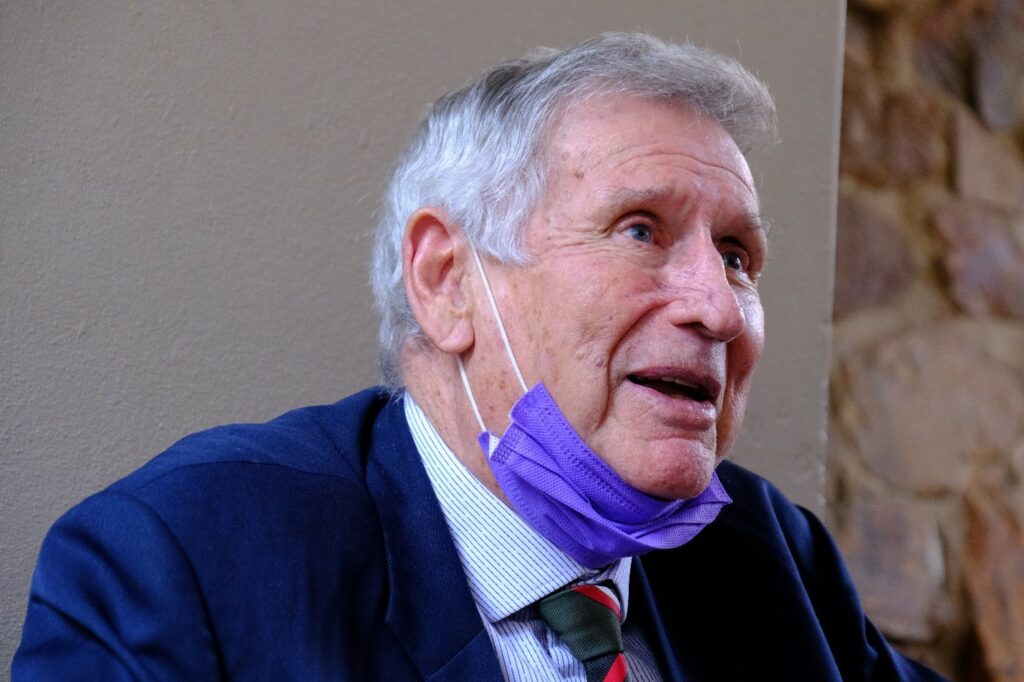
Mr Schroder described himself to the audience as a product of Rondebosch Boys High School in Cape Town. “So I am probably in danger of most of you here!” he quipped. “Rondebosch is the PBHS of the south and PBHS is the Rondebosch of the north! However, my association as Headmaster of PBHS for 20 odd years and a subsequent 12 in retirement has been extremely happy and enlightening”.
Rondebosch, established in 1897, is located in Cape Town’s ‘southern suburbs’ and is similarly modeled to PBHS. It’s also one of the topmost academic schools in SA and one of the oldest in the country.
Commenting on Mr Hassenkamp’s address, Mr Schroder mentioned that he (Greg), “was of my boys in my first year at the School. However, he came back to the School in 1999 and his first major appointment was as head of Solomon House. An Old Boy, he knew the ropes. It soon became wonderful to know that we had acquired a Housemaster of his stature.
“Greg also had a canny knowledge of what boys get up to and how to deal with tricky situations. He was always one step ahead and very successful in managing the House. For example, there was invariably hell to play in the boarding houses on the last school night of the year, and not uncommon for boarders to bunk out.
“On one occasion, after lights out, Greg placed a mattress on the inside of Solomon House’s front entrance and awaited the return of potential perpetrators. They had the shock of their lives when they entered the front door and found him lying there. ‘Where have you been’, he asked. ‘Just to the swimming pool Sir, no further’, was the retort. ‘We would never have left the School grounds!!!’ But Greg persisted, pointing out that their hair was dry and insisted on knowing where they had been. Eventually one boy admitted that they had been in the bell tower. ‘What? You know you’re not allowed there,’ exclaimed Mr Hassenkamp. ‘Yes,’ said the boy, ‘but I was just engraving my name on the bell, under your name’.
Mr Schroder noted that one of his most important priorities remaining is to establish a Trust at the School for the financing of bursaries for bright and promising young township learners deserving of a better place in society. He had previously dealt with the subject in his book A Headmasters’ Story – My Life in Education.
“Our top schools in SA, both public and independent, are on a par with the best schools in the world, but the other end of the educational spectrum is comparable with some of the worst in the world”, he wrote. “The challenge is to maintain those top schools and to work on the dysfunctional ones’ in order to narrow and ultimately close the gap that exists”.

Final reflections from Donald Jones:
May 1 was a beautiful autumn day at a magnificent School embraced by wonderful people. The most beautiful of all were the red roses at the East gate security entrance welcoming us all home!
Some had travelled long distances to Pretoria – Tom Brown from Durban, Alan Cave from the Wilderness, Micky Cooper from Cape Town who also brought his daughter and son-in-law, Peter Doyle from Hilton who again brought with him an amazing amount of delicious Wedgewood Nougat, Paul Erens from Knysna, Greg and Lyn Grobler from Paarl, Rod Stewart and Marj Corlett from Tzaneen, Peter and Di Marais from Bela Bela, and Graham Hearn, and his newly purchased jacket, from Hermanus.
Basil Ferne influenced Prof Eddie Green, an ex-teacher of the school, to attend as well as Ron and Eileen Brown. Ron Brown a teacher, past school inspector, and Founder member of Trinity House College was delighted to attend in spite of not being in good health.
The live streaming of the Assembly was a wonderful innovation and I was made aware of some that were virtually present – Wilf Brown from Hilton, Neil Donen from Canada, Jon Braude from London and Noel Durie who was in the Kruger Park and many others.
The Assembly was special and Tom’s address reflected everything that Boys’ High stood for. When it came to the singing of ‘Forty Years On’ Tracy Housden (Bill Schroder’s daughter) stood next to me in the Gallery upstairs. My wife, Jackie was at my side and Tracy had no programme so I offered her mine. She looked at me and declined but also wept and I shed a tear too.
Her tears were for her mother and her father who was sitting 2 metres in front of her and for all the wonderful memories she shared of Boy’s High with her amazing parents. My tears were ones of gratitude, gratitude to my parents who had the foresight of sending me to Boy’s High – gratitude that my wife was present with me on this momentous occasion. Gratitude to my friends present in the Gallery and the friends who are no longer here.
The luncheon was really special and to have the people of the quality of Phyllis and Tony Wilkes and Clinton Harrop-Allin made it more so. The Hassenkamp, Schroder interaction and repartee was palpable and something I will never forget. It is clear to all that that friendship is deeply respectful and caring. It is clear too that Pretoria Boys’ High School is in the capable hands with Mr Greg Hassenkamp as Headmaster.
My thanks to Steffani Kruger and her staff at the Old Boys Club, Sally de Beer, Leon Kok, Mike Theron and last but not least my wife Jackie for their support in making this a very memorable 60th Reunion.
Let us not forget Dame Vera Lynn at this time with her song
We’ll Meet Again
Thank you to all whom attended and we’ll meet again.

Acknowledgements:
Text: Leon Kok
Photos: Memos Kavalineas, Bronwen Bamford and Sally de Beer.
Please remember to send any snippet of interesting information to info@pbhsob.com for the attention of Sally